
Mother Nature (aka evolution) has come up with some very clever ways for fish, amphibians, reptiles, birds, and mammals to defend themselves against unwanted attention. These strategies include safety in numbers, speed, camouflage, mimicry, spines and other physical armor, sacrificial limbs… even electricity.

And let’s not forget chemical deterrents such as poison and venom (they are not the same thing, btw)… and then there’s odor, the harassment avoidance talent of choice for today’s featured guest, the Common Musk Turtle. The Latin binomial name couldn’t be more suitable — Sternotherus odoratus. More pointedly known by the nickname Stinkpot.
Found throughout southeastern Canada and the eastern half of the United States, Stinkpots live in wetlands and near rivers, streams, and creeks that have slow currents and muddy bottoms, as well as marshes, swamps, lakes, ponds, and ephemeral pools. As aquatic turtles go, they’re relatively small — the length of an adult’s domed shell measures no more than 5.5 in (14 cm). The shell (aka carapace) isn’t large enough to provide much protection for the turtle’s head and limbs, and the underside (aka plastron) is even smaller, with one hinge located between the two front legs. The triangular head has ivory-yellow striping from the pointy snout and sharp beak down the long neck, although these markings may become less noticeable with age.

Stinkpots spend most of their time in water. They’ll haul themselves onto rocks and fallen logs to bask in the sun, but rarely venture beyond the water’s edge. Curious, then, that they’re not good swimmers. For one thing, they’re less buoyant than other aquatic turtles, so they walk along waterway bottoms, adjusting their position in the water by varying the amount of air in their lungs. Because of their small size, understated countenance, and tendency to be more active after dark, Stinkpots are not as well-known to most people as, say, box turtles, red-eared sliders, and snapping turtles.
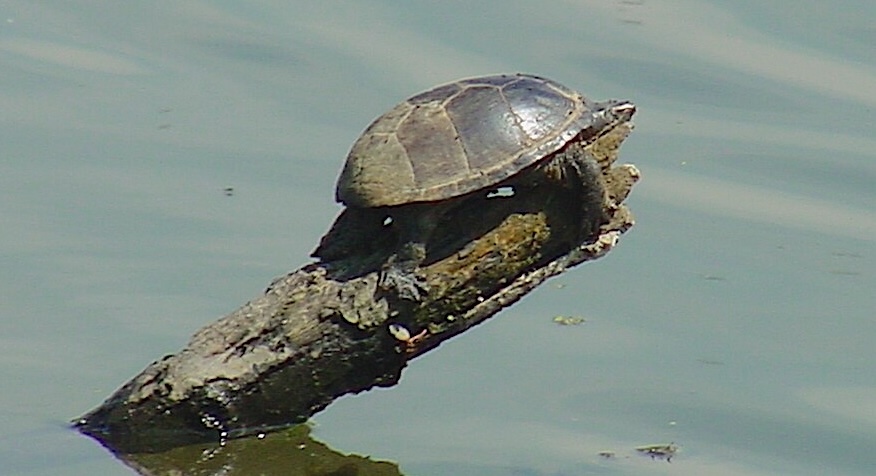
The Stinkpot comes by its common name honestly — when a predator comes to call, they’ll release a foul, musky substance from glands on the edge of their shell. Seriously, its one of the most powerful scents in all of Turtledom.
While odor isn’t an uncommon defense tactic in the Animal Kingdom, initially I found it puzzling that an aquatic animal would use scent as a defense against predation. Sure, Stinkpots have mammalian predators, and I didn’t have any trouble believing that raccoons, foxes, and river otters might lose their appetite once they got of whiff of what’s on that menu. Bald eagles, herons, egrets and other avian species, on the other hand, are also know to prey on Stinkpots but none of these species have a strong sense of smell, so a pungent perfume would seem to have a much more limited impact. And what about all of the aquatic and semi-aquatic predators, including largemouth bass, American bullfrogs, snapping turtles, and cottonmouths, to name a few?
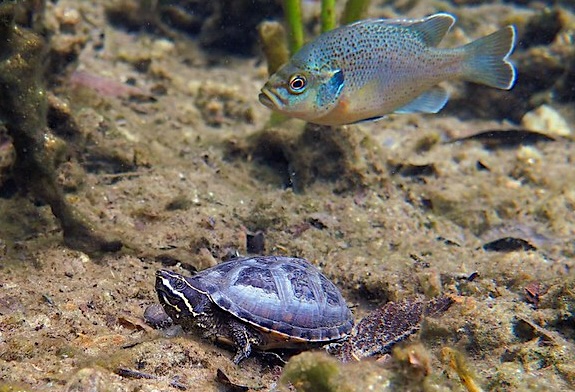
I started sniffing around, trying to solve this puzzle. Turns out, that musky secretion is a phenol — phenolalkalinic acid to be precise. Phenols are water-soluble compounds with what has been described as a distinctive, sickeningly sweet and tarry odor that can be detected in air at about 0.05 parts per million (ppm) AND in water at even lower concentrations. In other words, whether you live on dry land or under water, the Common Musk Turtle is hard to ignore.
I guess Mother Nature does knows a thing or two about chemistry, and how to be a Stinkpot, after all.

To be clear, Stinkpot turtles don’t rely on B.O. alone. They won’t hesitate to use their sharp beak and strong jaws in self-defense, and with a neck that can stretch all the way to their back feet, they can strike an attacker with surprising agility (well, surprising for someone wearing rigid body armor).
Unfortunately, this odoriferous reptile can’t always distinguish friend from foe. So, if said ninja turtle strays from the water’s edge onto a sidewalk and is in imminent danger of being stepped on… and an ally who happens by and only wants to help, I swear, decides to stop and give this drifter a ride home… all I can say is that Good Samaritan had better be extra careful because when this shelled fella bites, it really stinks!

Life is better with Next-Door Nature — click the “subscribe” link in the lower left-hand corner of the footer to receive notifications of new posts! Have a question about next-door nature? Send me an email and the answer may turn up as a future blog post.
© 2026 Next-Door Nature — no reprints without written permission from the author (I’d love for you to share my work but please ask). Thanks to the following photographers for making their work available through a Creative Commons license: Gordon Firestein; Charles J. Sharp; Holger Krisp; Ken Slade; John; USFWS-Midwest; USFWS-Northeast; Phil’s 1stPix; Andrew Hoffman; and Laurent Lebois. Thanks also to the following photographers for granting permission to use their work for this blog post: Iowa Herps.


_male_Montagne_d%E2%80%99Ambre_3.jpg)

.jpg)
.jpg)

Leave a comment