Last autumn, I walked along a popular path that circles a nearby neighborhood pond, taking note of the other humans who had ventured outdoors on this lovely autumn afternoon to stretch their legs or do a little fishing after work. I always notice the waterfowl who gather here as well… mallards, Canada geese, and a single ponderous domestic duck of some kind, possibly a hybrid, who I’d recently started calling Elvis after the bulkier 1970s version of the King. He and the mallards steer clear of one another, but the Canadas let him hang with them sometimes.
I also check out the small island in the middle of the pond. Depending on the time of year, I may spot a female mallard brooding her nest, or ducklings dabbling at the water’s edge, or an occasional sunning snapping turtle. One time, several years ago, I saw a great blue heron standing still as a statue, waiting patiently for dinner to swim close enough to spear.
But on this October day I looked, and looked again, and still couldn’t believe what I thought I was seeing. “Is that a cormorant?” I said under my breath.
“No, that can NOT be a cormorant…” I said in disbelief, loud enough to turn the heads of the fishermen I passed as I tried to get a better view. Then the bird moved into a patch of sunlight, stretched out it’s neck, and removed all doubt.
“Oh my god, THAT’S A DOUBLE-CRESTED CORMORANT!” I nearly shouted to the anglers, who looked at me like I was speaking in tongues.
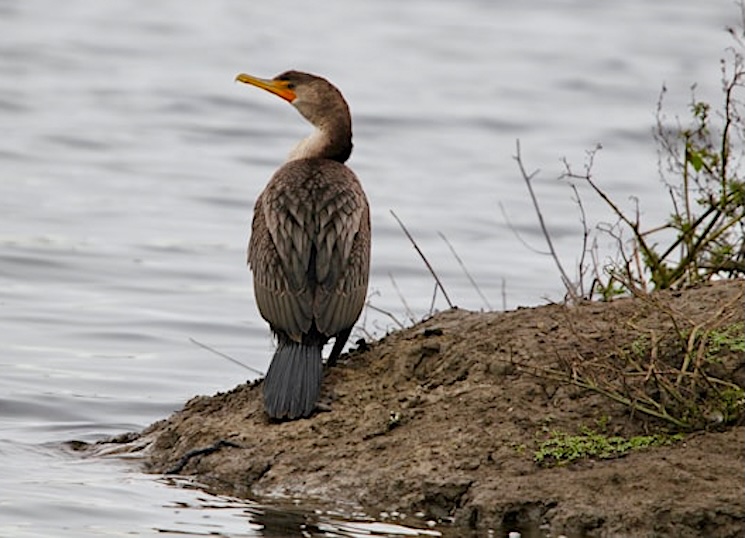
I guess it might help to share some context for why I was so surprised and excited by this taupe, buff, and black bird.
I moved to southwest Virginia about two years ago, to be closer to the main campus of Virginia Tech — I’m the Program Director for the VT Online Master of Natural Resources degree. Back in the late 1990s, during my time as the Executive Director of a large wildlife rehabilitation center in Houston, Texas, I became familiar enough with double-crested cormorants (DCCOs) to know that these birds don’t live in Appalachia.
I’ve moved often enough over the course of my life and, as was the case with this most recent move, I’ve also returned to places I’ve lived before. As a result, I feel a kind of kinship with migratory species. I knew that DCCOs do travel through this part of the region twice a year, in the spring (mid-March— late April), and in the fall (mid-October — mid-November). So nothing out of the ordinary on that score.
What threw me was that I also knew DCCOs migrate in flocks, following rivers or coastlines, yet I was looking at a solitary juvenile bird in the middle of a small pond approximately 5 miles from the nearest river.
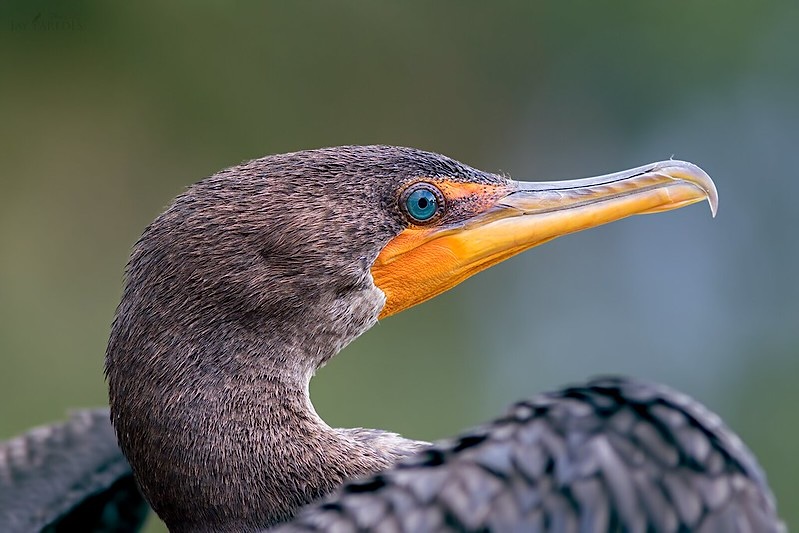
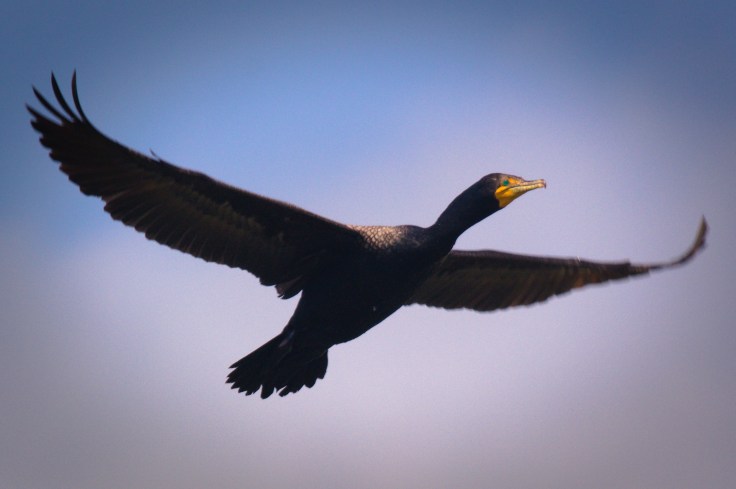
Cormorants have a very distinctive physique, with a stocky body weighing from 3.3— 6.6 lbs (1.5— 3.0 kg), a 4 ft (1.2 m) wingspan, short, dark legs, and a long neck that’s often the only part of the bird visible above water when they’re swimming. They also have dazzling teal-blue eyes.
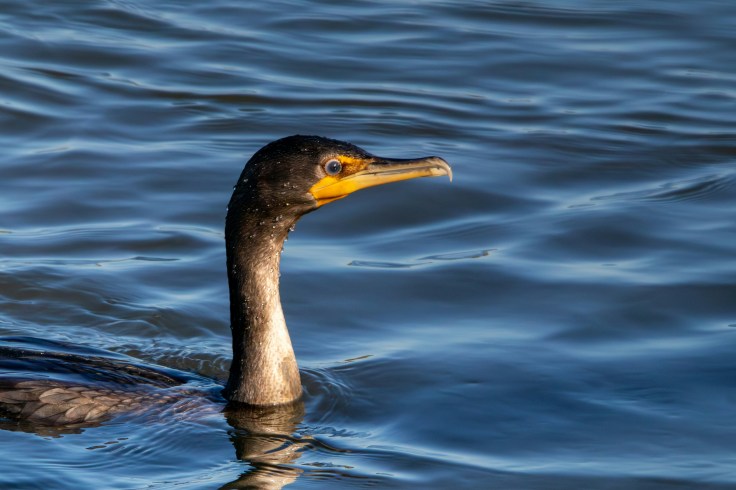
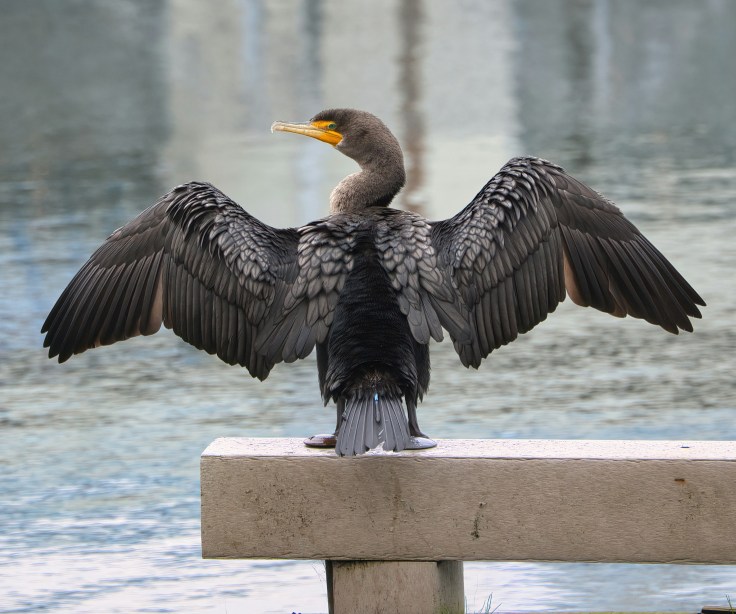
DCCOs are built to dive from the surface, chasing fish underwater and catching them with a sharp, hooked beak. Cormorants can dive as deep as 24 ft (7.5 m), propelled by their webbed feet, and then stay submerged for 60 – 70 sec before coming up for air. Their feathers are not waterproof – that reduces buoyancy, which is a helpful trait for a diving bird. They’re often observed standing on land or perched on a branch or pier with their wet wings outstretched to dry after a swim.
Because it was young and alone, and because of my wildlife rehab background, I watched for a while and did a quick visual triage. Maybe it had to drop out of the migrating flock and land in the closest body of water due to an injury or illness. But it looked perfectly normal, other than being alone. I noticed the sun was setting. Time end my walk, pick my dog up from her groomer, and head home. I bid the cormorant a quiet farewell and sent a wish for traveling mercies, then turned to walk back to my car.
When I came back the next day I found only the usual feathered suspects hanging out at this local watering hole. I can only guess that, having rested and refueled, the bird decided to continue south to Florida. I have no idea why this blue-eyed traveler was flying solo. Just a young rambling rebel, perhaps. An avian kindred spirit of Kerouac, who, “had no place he could stay in without getting tired of it, and because there was nowhere to go but everywhere, keeps rolling under the stars…”
Life is better with Next-Life is better with Next-Door Nature—click the “subscribe” link in the lower left-hand corner of the footer and receive notifications of new posts! Have a question about wildlife and other next-door nature? Send me an email and the answer may turn up as a future blog post.
© 2026 Next-Door Nature — no reprints without written permission from the author (I’d love for you to share my work but please ask). Thanks to the following photographers for making their work available through a Creative Commons license: Jay Paredes, Anish Lakkapragada, Chris Mclaughlin, Townsend Walton, and Avian Photography.
 Next-Door Nature
Leave a comment