I’m going to let Next-Door Nature readers in on a little-known fact about me… I started walking quite early in life. I was 8 months old. According to the Cleveland Clinic website, the average age at which human babies start to walk is 12 months although some of them procrastinate until 17 or 18 months. Of course, I have no memory of any of this but my mom told me about it and I trust her. I guess I must have been in a hurry to get somewhere because I didn’t bother learning to crawl first. Mom said my pediatrician was concerned that I wasn’t going through the developmental milestones in the usual order (a foreshadowing of things to come throughout my life).
The experts say crawling is a pretty important skill for humans to have — it helps you develop balance and bilateral coordination, which are essential for activities like running, skipping, jumping… even handwriting. Crawling is also important for risk perception, like determining whether a situation is safe or not. Learning to crawl, or not, has been shown to be a predictive data point for whether a baby is likely to fall into a tub of water (I kid you not).
But in my case there was no real cause for alarm, because after I learned to scamper around the house on two feet I did get around to learning to crawl on all fours, too. Turns out, while crawling is an important developmental milestone for toddlers, you are allowed to apply a little creativity to when you accomplish it. In other words, you don’t always have to walk before you run crawl before you walk (words to live by, in my opinion).
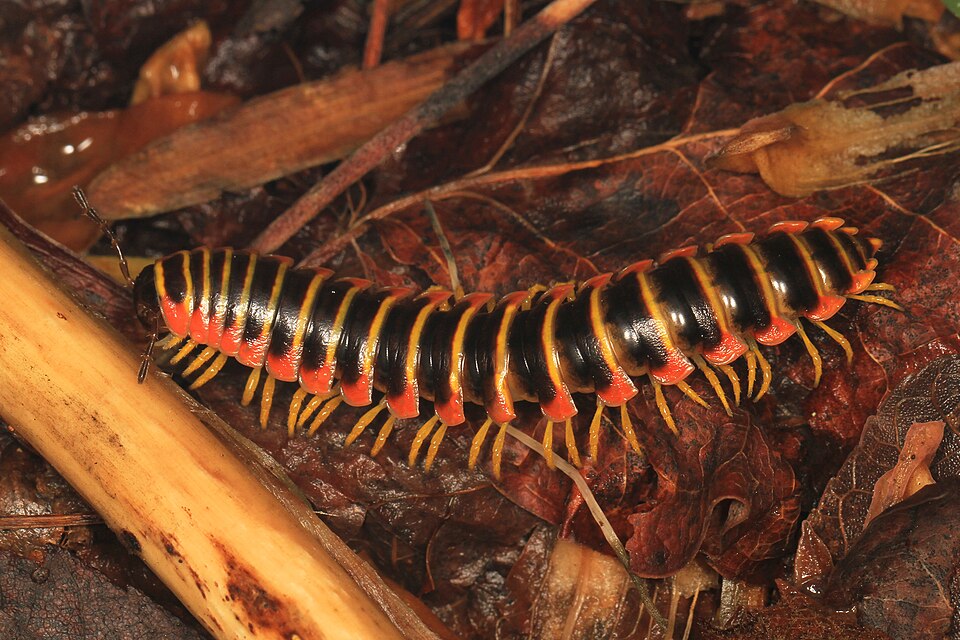
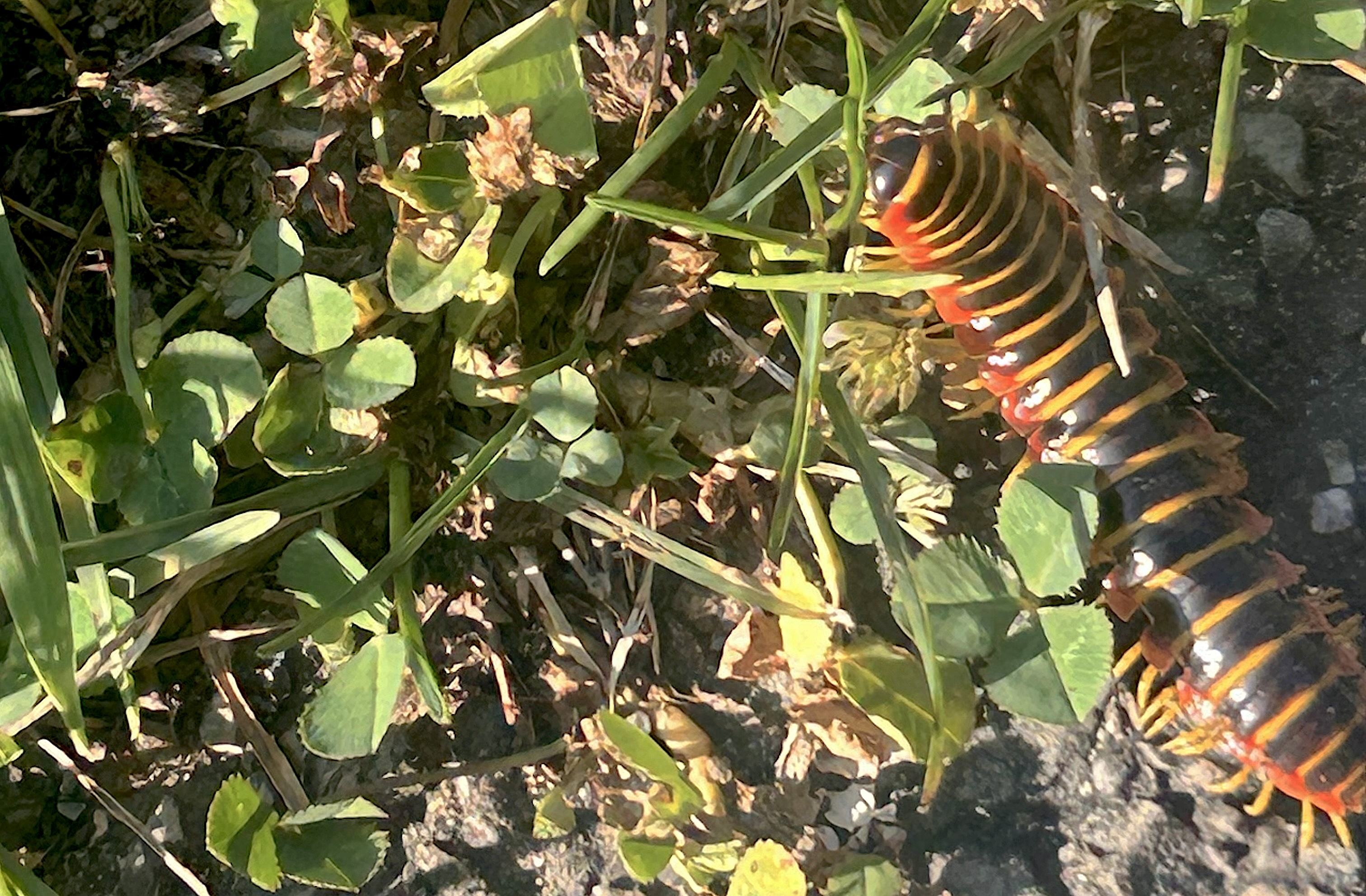
Based on all of that, I think you’ll agree I’ve made the case that when it comes to walking, I’m a natural. I’ve been doing it for over six decades now, and I don’t have any problem meeting my minimum daily goal of 10 thousand steps most days. Even so, when I saw a Black and Gold Flat-backed Millipede (Apheloria virginiensis) hot-footing it across the trail on one of my recent strolls, I had to admit that I’m a rank amateur compared to this leggy creature.
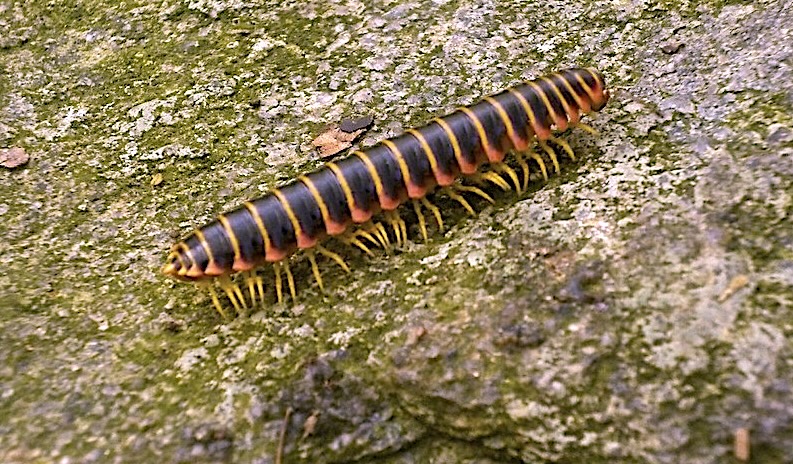
Okay, okay… millipedes don’t actually have a thousand feet (milli = 10⁻³ ; poetic license isn’t limited to poets), but they may have as many as 60-62 feet, depending on whether the individual is male or female (more on this later). Walking back to the car, I couldn’t help but wonder if 10 thousand steps would be as ambitious a goal for a B&GF Millipede as it is for me. Think about it — for every one step that registers on my Fitbit Zip, a B&GF Millipede would log 30 or 31.
Once I finished calculating that comparison, trying to wrap my head around the task of coordinating dozens of pairs of feet without tripping made me want to stop and sit down. And don’t get me started on how much extra time it would take to put on socks and shoes!
Before I get into how B&GF Millipedes accomplish their complicated choreography, I should probably introduce you to this member of the Xystodesmidae Family.
Found only in parts of Virginia and North Carolina, they were the first documented millipede in North America. In 1770, British zoologist Dru Drury described these arthropods based on samples he received, and then assigned the binomial name Julus virginiensis. As we’ve learned more about this genus, B&GF Millipedes have gone through a number of name changes, including: Apheloria tigana (Chamberlin, 1939); Apheloria virginia (Chamberlin, 1939); Apheloria waccamana (Chamberlin, 1940… I guess Chamberlain had a hard time making up his mind); and currently Apheloria virginiensis (Hoffman, 1999).
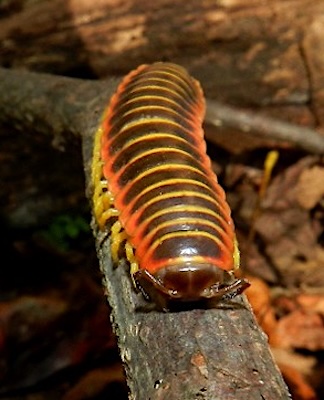
B&GFs are also known as Virginia Cherry Millipedes because as a defense mechanism they excrete two compounds that smell like cherries or almonds or both — hydrogen cyanide and benzaldehyde. Both are mild toxins that aren’t usually a problem for humans but it’s a good idea to wash your hands if you handle them, just in case, and don’t let your dog or cat eat them.
As millipedes go they’re rather large (1-2.5 in or 27-59 mm long). Females tend to be larger than males, which is pretty common in the Animal Kingdom. As the name suggests, they are relatively flat, at least compared to cylindrical and pill millipedes. But common names can also be misleading, so while the most common color pattern is primarily black with yellow legs and spots along both sides, just as you’d expect, some B&GFs may have pink or orange legs and spots.
Like most species in Order Polydesmida, the adult B&GF body is comprised of individual segments, and in the case of millipedes each segment has two pairs of jointed legs. Females have 31 pairs of legs while males have 30 — that’s because on males, the Pair 8 legs transform at maturity into gonopods, appendages that transfer sperm during mating.
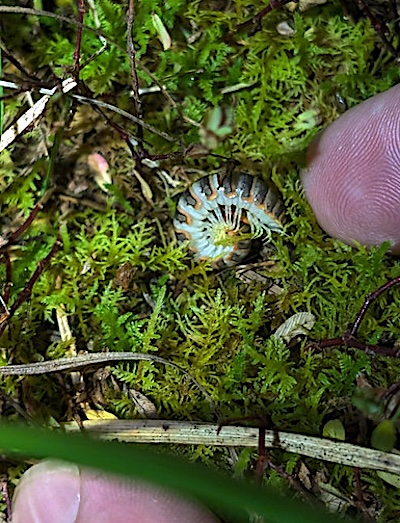
Speaking of reproduction… millipedes follow a pretty standard approach among invertebrates. You know, boy meets girl sometime between late spring and mid-fall, there’s a brief hook-up, then he wanders off in search of something to eat, and she wanders off to look for a suitable nursery. In this case “suitable” means a damp protected area, usually beneath a rock or log, that has enough decaying leaves to feed her nascent offspring once they hatch from the eggs she’ll deposit in the soil and then leave behind without a backwards glance.
A couple of months later, when the nymphs hatch, they’re rather soft and pale, with a head and only one or maybe two pairs of legs, along with some legless segments. They don’t move very far or fast at this stage — kind of the millipede version of crawling — especially if there are plenty of rotting leaves to eat nearby. As they grow over the next two to three years, they develop a harder exterior cuticle which splits and is shrugged off during multiple molts, becoming darker with brighter coloration, adding more segments and legs each time. And as they get bigger and leggier, they become more mobile and begin to explore the world around them.
Which brings us back to the challenge of moving through the world on myriad feet without tripping. According to Petra Sierwald, a zoologist and Associate Curator at the Field Museum in Chicago, it’s important to understand that millipedes don’t walk like birds and mammals, placing one foot in front of another. Their legs and feet work in teams of three or four, coordinating which teams move forward and which swing backwards into position for the next step… make that steps.
Based on that description, what I’m picturing is a rowing team. Except instead of everyone on the team moving their oars in unison, they’d be organized into subsets so that some would be pulling their oars through the water and some would be lifting their oars out of the water, creating constant forward momentum instead of the surge-and-pause rhythm we’re used to seeing… but doing so without hitting other rowers’ oars as they pass over or under each other.
Good grief! That mental image is even more paralyzing than trying to figure out how to get from Point A to Point B with five dozen appendages.
So I think I’ll just have a seat, watch a B&GF Millipede stroll through some clover, and be grateful I get to stand and walk on my own two feet.
Life is better with Next-Door Nature — click the “subscribe” link in the lower left-hand corner of the footer to receive notifications of new posts! Have a question about next-door nature? Send me an email and the answer may turn up as a future blog post.
© 2026 Next-Door Nature — no reprints without written permission from the author (I’d love for you to share my work but please ask). Thanks to the following photographers for making their work available through a Creative Commons license: Judy Gallagher, Paul, Nancy Magnusson, schizoform, and Kieran Lindsey.


Alicia did the same
Thanks for sharing, Pat… I’m glad to know I’m not the only kid who was impatient to walk LOL