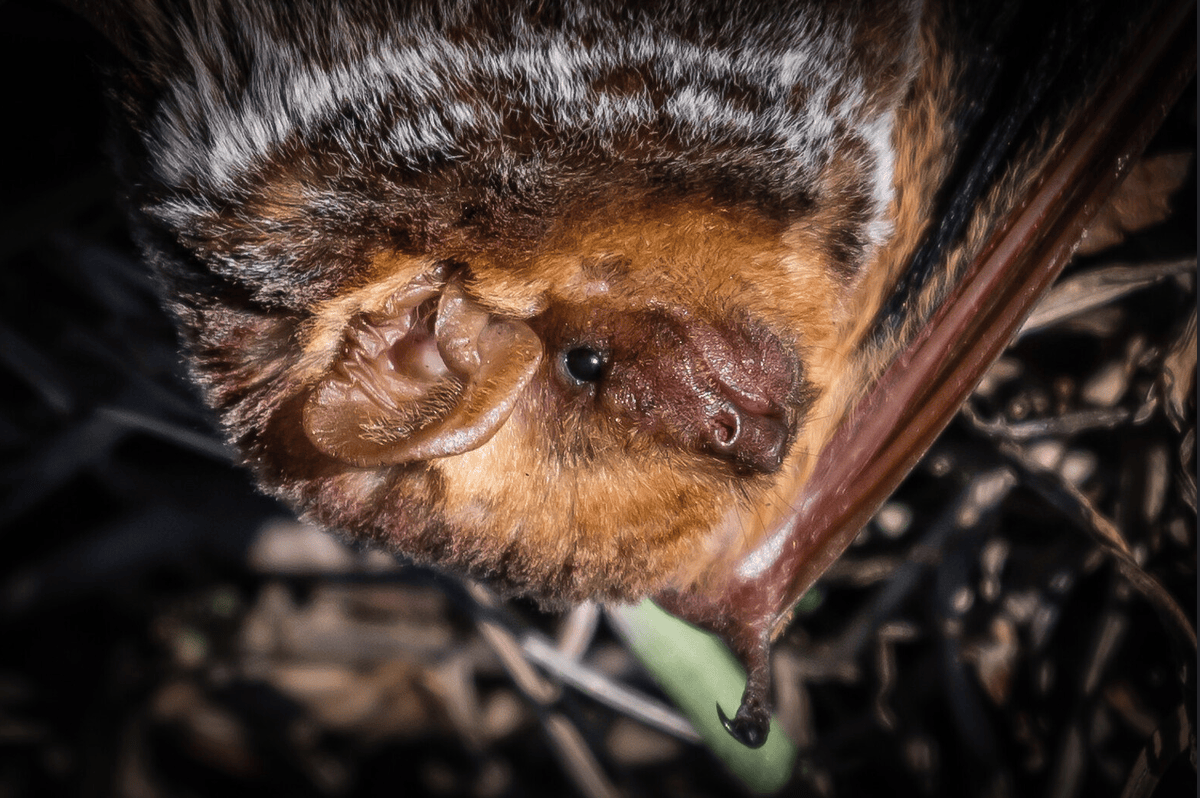
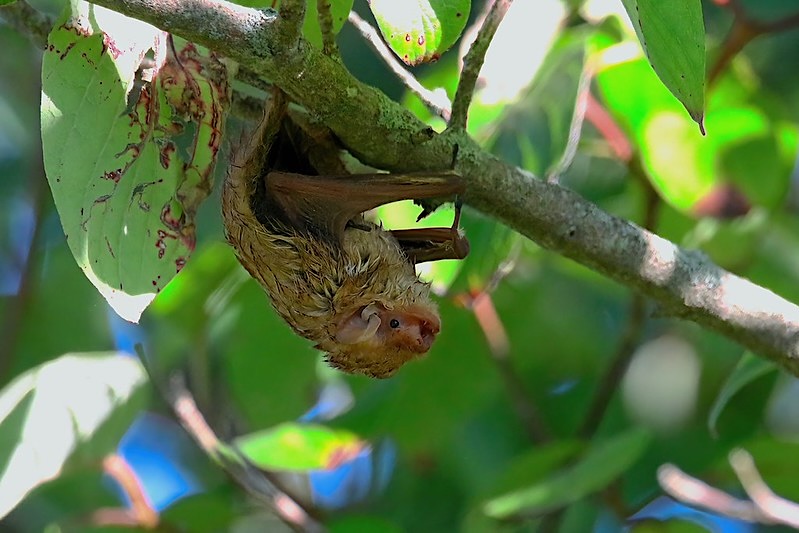
Next time you pull a Goldilocks and start grumbling that your bed is too soft or too hard, just be thankful that you don’t have to sleep hanging by one foot so you can blend in with dried leaves or pass for a pine cone like the Eastern Red Bat (Lasiurus borealis).
I know, I know… the stereotypical bat home is a cave. And it is true that some species, including big brown bats (Eptesicus fuscus), little brown bats (Myotis lucifugus), silver-haired bats (Lasionycteris noctivagans), tri-colored bats (Perimyotis subflavus), and Indiana bats (Myotis sodalis) to name but a few, do use caves at least part of the year for hibernation, as maternal roosts during breeding and pup-rearing season, or both.
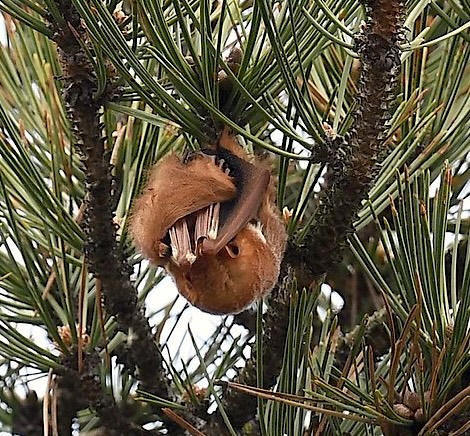
But Eastern Reds are tree bats. They use bark crevices and branches as their bedrooms and nurseries in summer, and tuck themselves into tree cavities, woodpiles, and beneath leaf litter for their long winter naps. Typical of tree bats, they’re solitary creatures even during hibernation whereas cave bats tend to congregate, especially when Jack Frost hits town.
Distributed across North America east of the Continental Divide from Canada south to Mexico and Bermuda, Eastern Reds are a medium-sized bat – approximately 3.75–4.5 in (95–114 mm) from head to tail and weighing in at between 0.25–0.50 oz (7–14 g). Males have been described as having fur that’s “Irish Setter red,” while the frosted fur of a female is a softer coppery red. Both males and females have eye-catching white shoulder and wrist patches that make the species easy to identify.
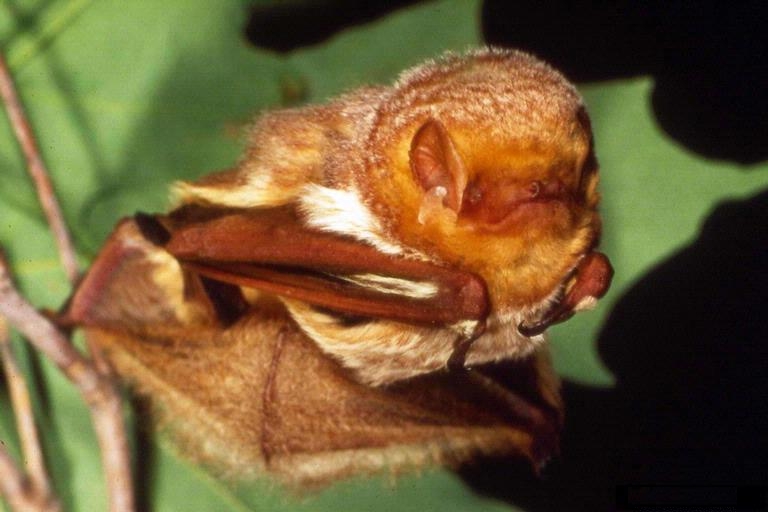
Eastern Reds are a Species of Least Concern, an International Union for Conservation of Nature (IUCN) classification indicating they are widespread and abundant. Perhaps that’s because when we get to the Happily Every After portion of this tale, Eastern Red gals bring more than oddly-sized shoes to the honeymoon.
Eastern Reds hook up and get busy in late summer, before migration or hibernation, and a bit earlier than many small mammals. As to when and where reproductive activity occurs… let’s just say that all the adults in this species are members of the Mile High Club and leave it at that. But here’s an interesting plot twist… Eastern Red females are able to delay fertilization for months, until the following spring!
Sounds like the kind of magical power the Brothers Grimm would bestow upon one of their characters, doesn’t it?
Here’s another characteristic of Eastern Red ladies that puts “shoe size as a unique identifier” to shame. In late spring or early summer, most bat species produce one offspring, or on a rare occasion two. Lucky for those twins, most bats also have two breasts. Not to be outdone, Eastern Reds commonly produce as many as three or four young at once – a veritable litter! But never fear, this mom’s got a spigot for every one of her quadruplet munchkins.
But wait, there’s more! Remember when I told you that Eastern Reds rest hanging from a branch by one foot, avoiding detection by blending into bark or foliage? Well, now there are 4-5 bats hanging from that single foot – Mom’s hanging on to the branch and the babies are hanging on to Mom. Just imagine for a moment the strain on that foot when the youngsters start jostling for a place at the milk bar, or get restless and want to go exploring across Mom’s back or over the top of her head.
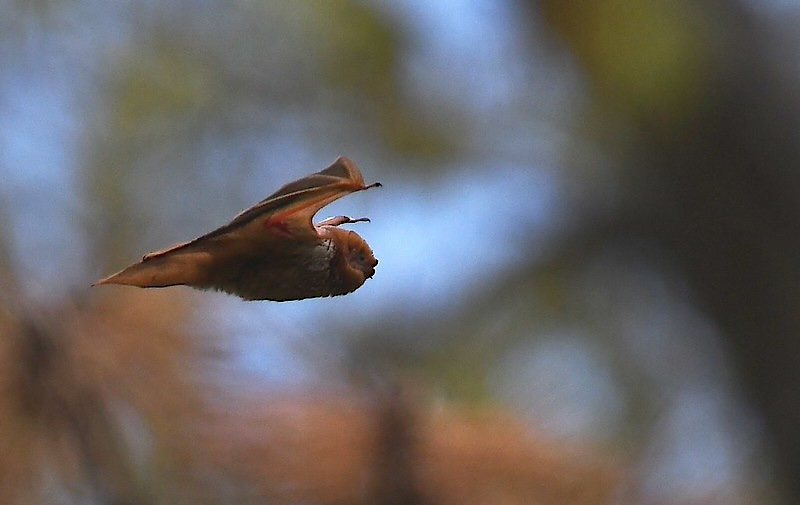
And when it’s time for her to look for some flying insects to eat (producing milk is very metabolically demanding), Eastern Red moms don’t leave their offspring back at the tree-house. These aren’t latchkey kids. Their mom takes them along for the ride… on the flight.
And sometimes that flight turns into a fall.
Back in the late 1990s, when I was the Director of the Texas Wildlife Rehabilitation Coalition (TWRC) Center, at least two or three times a summer someone would come through the front door carrying a shoebox that contained a female Eastern Red covered in babies. The whole family had been found on the ground, probably not far from where they landed when the load of wiggly pups was too much for Mom to remain aloft.
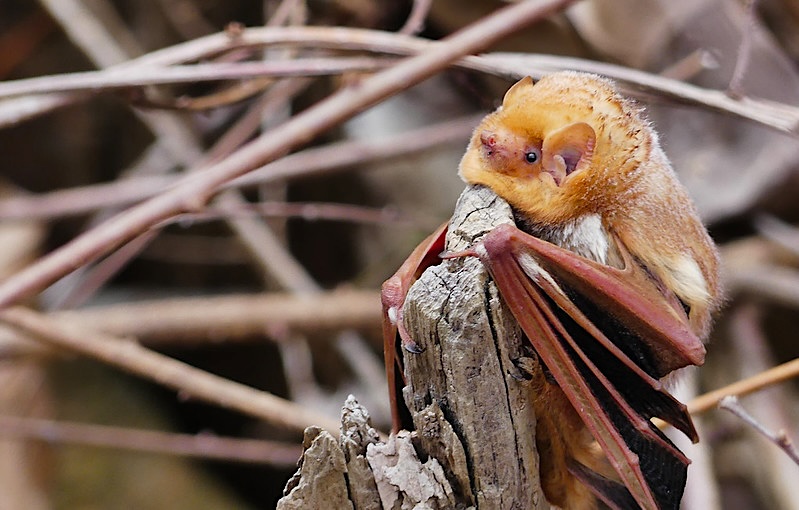
Keep in mind that the vast majority of bat species can’t take off from the ground like a bird. They have to scramble over to some vertical surface, then climb high enough to drop and let gravity help them gain enough speed for flight. Bats can crawl but it takes a lot of effort, especially when you’re the taxi for three or four kids, so if a vertical surface is too far away, or Mom is injured during the fall, or overheated and dehydrated, or simply too exhausted to move, they’ll family remains grounded… until, if they were lucky, a compassionate human wandered by, and then called their local wildlife rehabilitation center to ask for guidance on how to help.**
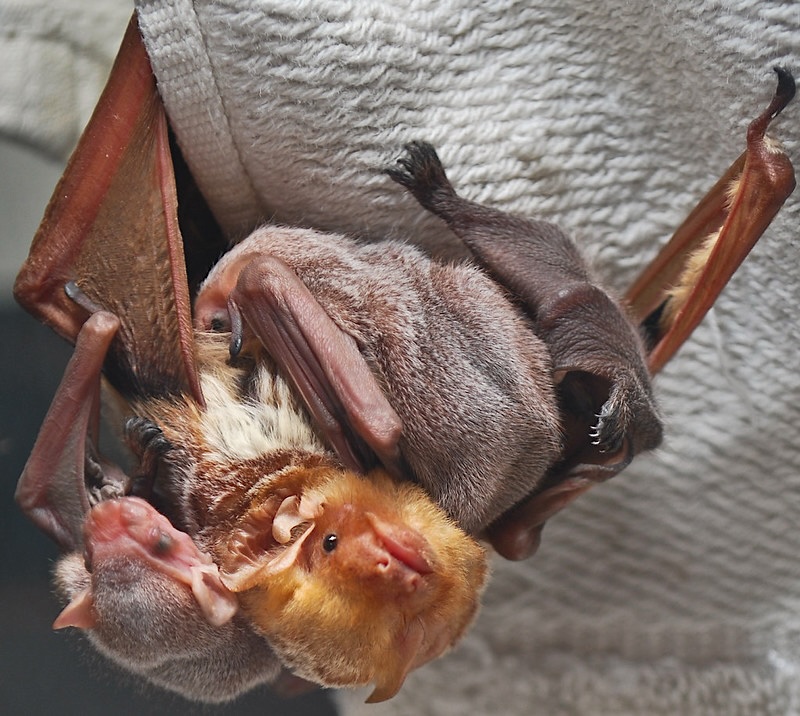
Once admitted, we would check for injuries, get everyone stabilized, then call one of our bat rehabilitators to come in to the Center for a pick-up. The family would receive food and shelter, hanging out in an enclosure designed specifically for bats until the youngsters were old enough to fly. Then the whole crew would be released back into the wild together.
All I can say is, I don’t want to hear another word from Goldilocks or that princess who whined about having to sleep on a pile of mattresses stacked atop a single pea. Those gals need to woman up! (Maybe they should adopt the female Eastern Red Bat as their role model!)
Happy Halloween!
** If you find a grounded bat, of any species, call your local wildlife rehabilitation center immediately and ask for assistance. DO NOT pick up a bat with your bare hands. Bats are rabies vectors, and you need to take that very seriously. In humans, once symptoms of infection begin the outcome is, with extremely rare exception, death. You do NOT need to be bitten to contract rabies – the rabies virus is carried in saliva and wild mammals groom themselves with their tongues. If you have even a small cut on your skin you could be infected. Wildlife rehabilitators who work with bats receive pre-exposure preventative vaccinations every 2-3 years so they can safely handle these and other Rabies Vector Species (RVS).
Life is better with Next-Door Nature — click the “subscribe” link in the lower left-hand corner of the footer to receive notifications of new posts! Have a question about next-door nature? Send me an email and the answer may turn up as a future blog post.
© 2026 Next-Door Nature — no reprints without written permission from the author (I’d love for you to share my work but please ask). Thanks to the following photographers for granting permission to use their work: Don Angle, Kevin McGhinnis, and Devin Griffiths. Thanks also to the following photographers for making their work available through a Creative Commons license: Andy Reago & Chrissy McClarren, Susan Ellis, Andy Reago & Chrissy McClarren, and Josh Henderson.


Leave a Reply