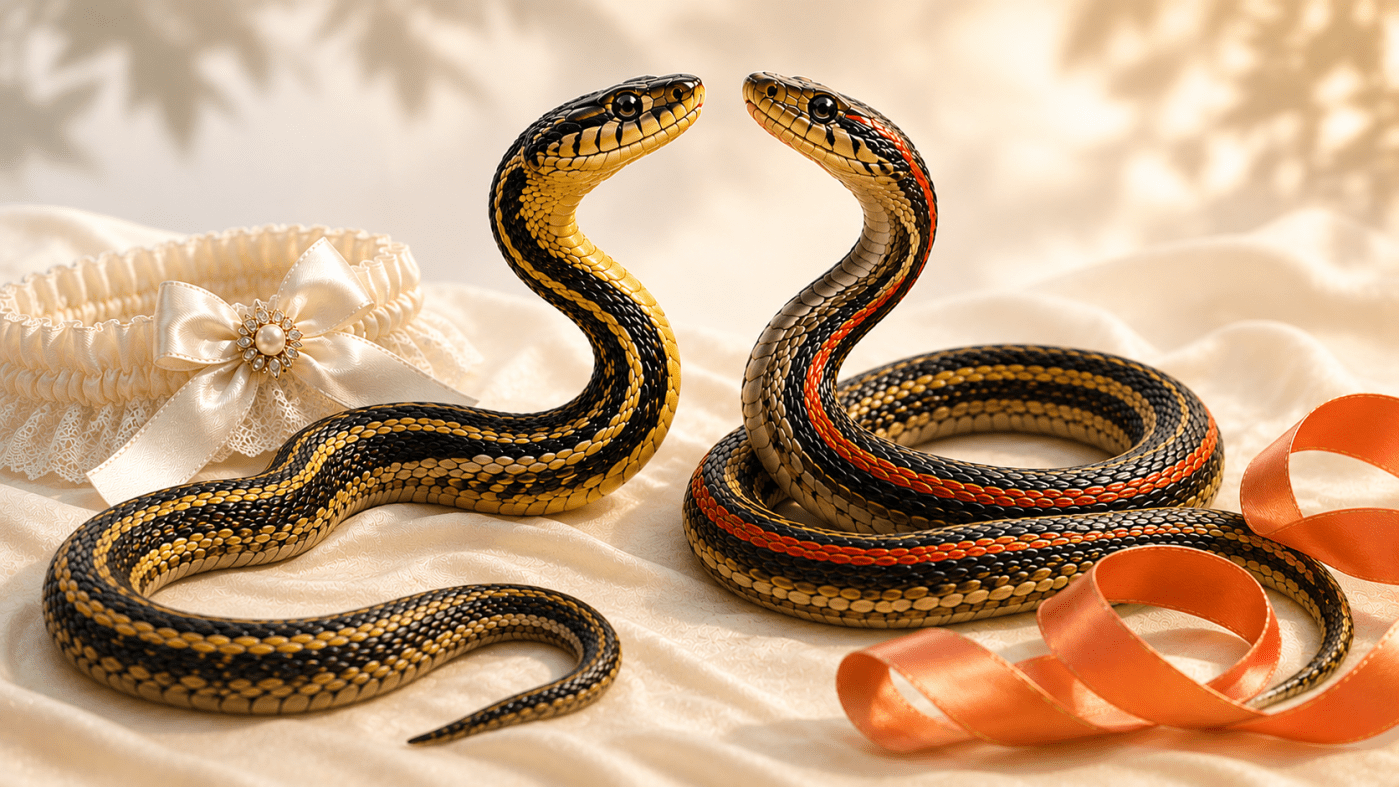
Wedding celebrations are June’s claim to fame, so this month seems like the perfect time to talk about garters and ribbons, don’t you agree?
Garter snakes and Ribbon snakes, of course — this is Next-Door Nature, after all.
“Garter” and “ribbon” are two of the common names for a group of 37 recognized species and 52 subspecies (Thamnophis spp.) of slender, small-to-medium (18—51 in / 46—130 cm) snakes found in North and Central America from Canada to Costa Rica. Members of this genus all have a flat, vaguely oval-shaped head, large round eyes with spherical pupils, and keeled scales, but that’s where the similarities end. You can see the family resemblance but would probably guess “cousins,” not “siblings.” Most (but not all) have stripes that run down the length of their bodies, some (but not all) have spots, and they come in a wide range of colors, including beige, black, blues, browns, reds, and yellows.
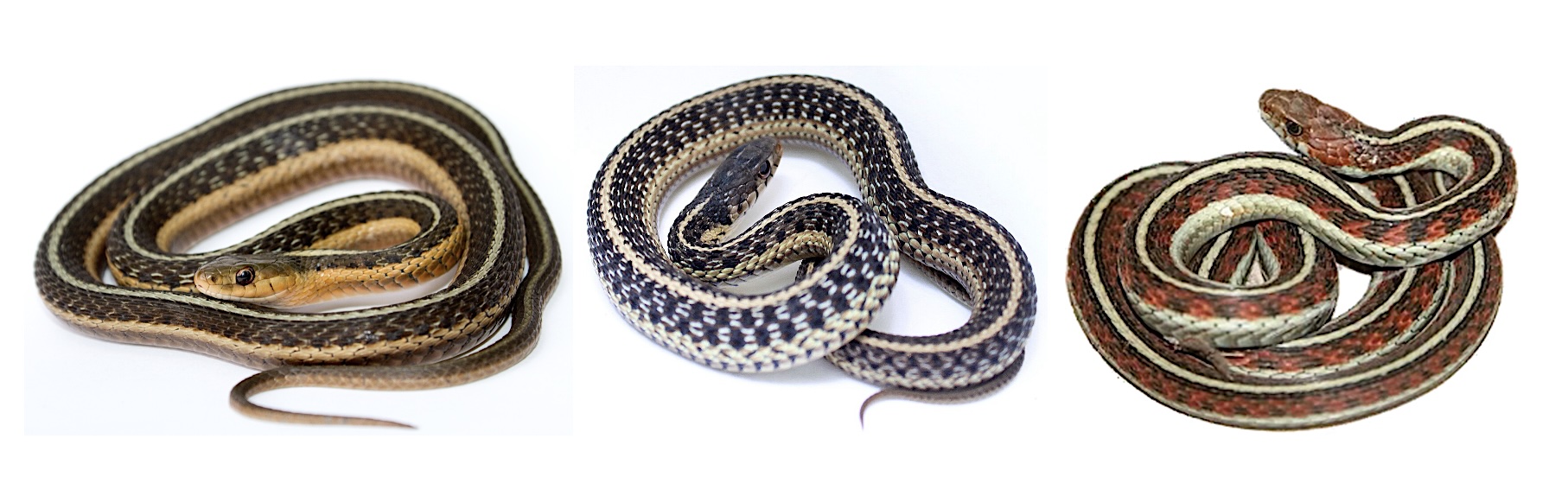
L to R: Butler’s Garter Snake (T. butleri), Checkered Garter Snake (T. marcianus), and California Red-sided Garter Snake (T. sirtalis infernalis).
The diversity of this genus isn’t limited to appearance, though. They inhabit a variety of habitats — fields and forests, prairies and parks, farmlands and flower gardens — but always near some source of water, and Thamnophis species in western North American tend to be more aquatic than their brethren east of the Mississippi River. All of these snakes are opportunistic feeders, meaning they’ll eat pretty much anything they can capture. Terrestrial prey includes worms (both earthworms and slugs), snails, insects (beetles, crickets, grasshoppers), spiders, lizards, and small mammals (mice, shrews, voles). Also on the menu are aquatic and semi-aquatic prey such as invertebrates (crayfish, insect larvae, leeches), small fish and fish eggs (guppies, minnows, mosquito fish), and amphibians (frogs, newts, salamanders, toads, including eggs, larvae, and tadpoles).
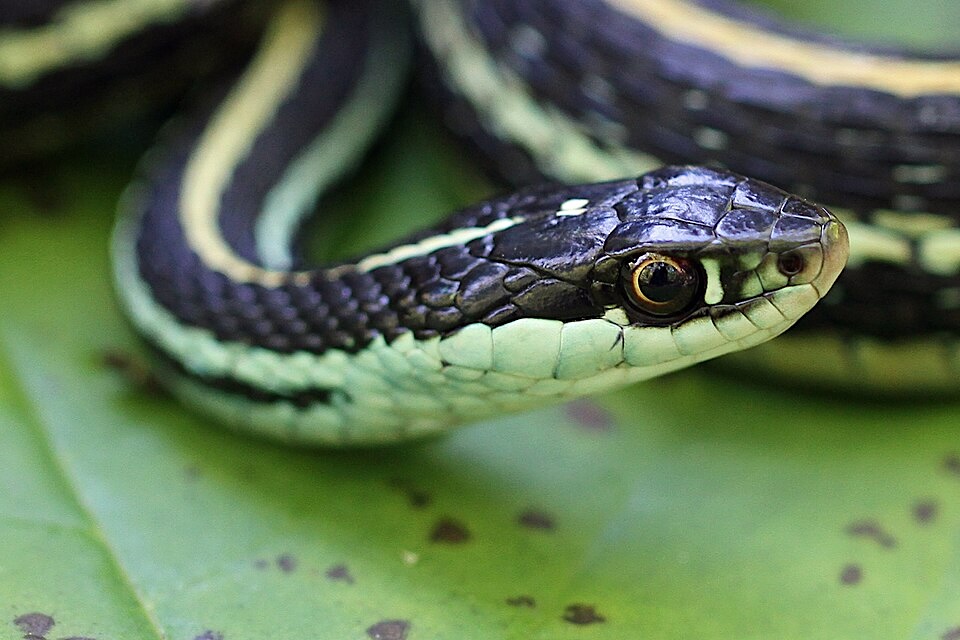
Eastern Ribbon snake (T. saurita).
Since I introduced this post with a reference to the traditional month for coupling, I suppose I need to share the story of serpentine romance. If you detect some hesitation on my part, you’re not wrong. This is not a meet-cute boy-meets-girl fairy tale… more like a boys-meet-girls-and-everyone-hooks-up fornication tale.
The action begins when the snakes begin to emerge from hibernacula sometime in March or April. Males appear first, and the competition for access to the ladies begins even before they arrive at the party.

You see, Garters and Ribbons use pheromones to find one another by following scent trails. Each gender has it’s own distinguishable aroma.
Well, sort of…
At the beginning of the breeding season, some dudes can also produce female pheromones, which they use to lure other males away from hibernation burrows where the dames are still snoozing. Once his suitor has been led far enough astray, the imposter cranks up production of a more manly cologne and hightails it back to the den, and with any luck he arrives just as all those sleeping beauties awaken.
There have been some studies that suggest males who deceive their rivals using this kind of mimicry do manage to mate with more females than those who don’t. Overall, though, because populations of Garters and Ribbons tend to have way more males than females, the more common situation is that one or two emerging females will be swarmed by ten or more males, forming mating balls.
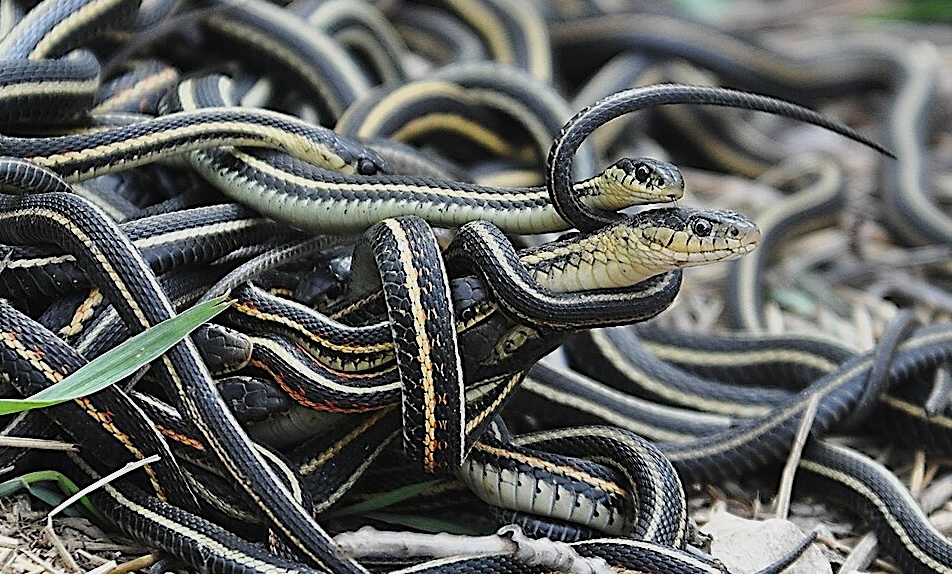
Common Garter Snakes (Thamnophis sirtalis) in a mating ball.
At that point it’s just a free-for-all and nobody is even exchanging phone numbers, much less wondering whether this is Mr. or Ms. Right (it would be hard to even figure out who is who) or daydreaming about wedding bells and happily every after.
Once everyone disentangles they go their own way. In July or August, the females give birth ovoviviparously (the eggs develop and hatch inside their bodies) to 10-20 young. The newborns hang out near their mom for a couple of hours or days until — you guessed it — everyone goes their own way. Males are mature enough to join the scrimmage in about a year, females are ready to rumble in two to three years.
Hey, it’s not my cup of punch but to each his own, I suppose. Every species has it’s own idiosyncrasies. But when you think about it, how ironic that these randy creatures are named for an item that’s a symbol of matrimony and fidelity. Especially nowadays, when weddings are just about the only reason anyone buys a garter anymore because nobody needs them to hold up their socks.

Eastern Garter Snake (T. sirtalis sirtalis)
Life is better with Next-Life is better with Next-Door Nature—click the “subscribe” link in the lower left-hand corner of the footer and receive notifications of new posts! Have a question about wildlife and other next-door nature? Send me an email and the answer may turn up as a future blog post.
© 2026 Next-Door Nature — no reprints without written permission from the author (I’d love for you to share my work but please ask). Thanks to ChatGPT for help with the hero image, and thanks to the following photographers for making their work available through a Creative Commons license: Brian Gratwicke; Brian Gratwicke; Don Loarie; Jaden Clark; Greg Schechter; Glacier NPS; Chris Friesen courtesy of Oregon State University; and Bill Keim.
 Next-Door Nature
.jpg)

.jpg)
.jpg)

.jpg)


Leave a comment