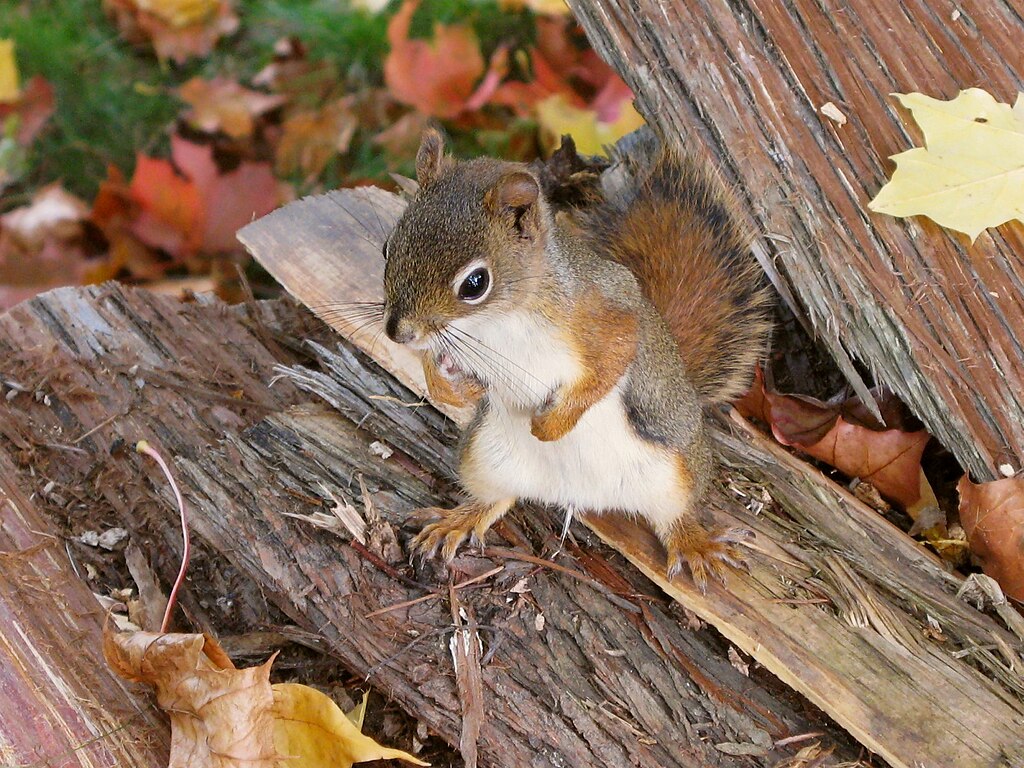
It’s not the size of the dog in the fight that counts, but the size of the fight in the dog. So we’ve been told, although there’s an ongoing quarrel over exactly who did the original telling.* Whatever. I’m here to tell you, right here and now, that the same sentiment applies in spades to the American red squirrel (Tamiasciurus hudsonicus). This rodent is confident, assertive, and enormously courageous despite being much smaller than gray squirrels (Sciurus spp.) and fox squirrels (Sciurus niger), and Lilliputian compared to domestic canines, including most toy breeds.
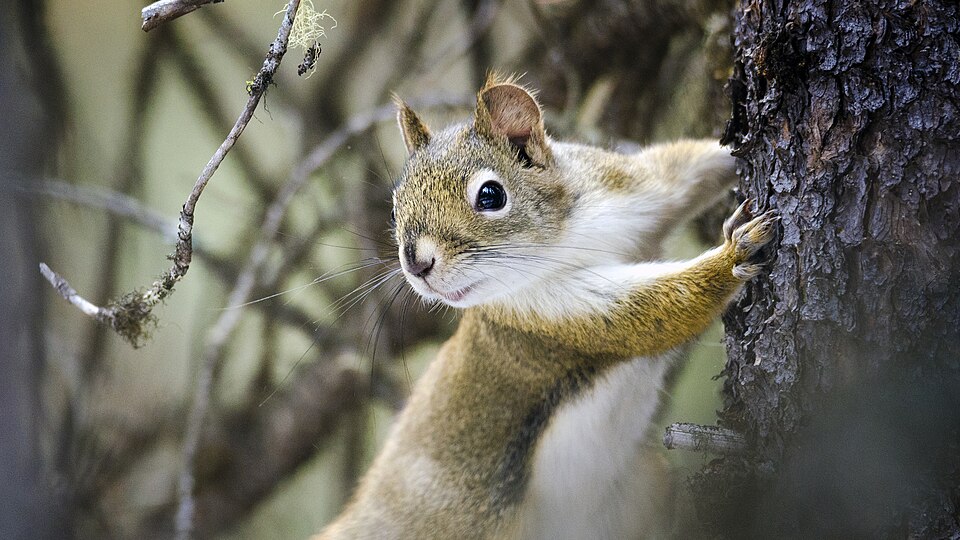
Also known as pine squirrels, chickarees, or boomers, depending on the region, populations of this species can be found across North America, including most of Canada, southern Alaska, throughout the Rockies, and on the eastern side of the continent as far south as Georgia. Abundant and active during daylight hours, Reds are easy to ID, with their bright auburn fur, charcoal shadings on their sides and tail, and snowy white eye-rings and belly. Taking their proportions into account helps, though, because size does matter when it comes to field identification. It’s useful to know that Reds weigh in at 7-9 oz (200-250 g) and measure 11-14 in (28-35 cm) from nose to tail— about half the size of their fox and gray cousins but larger than a chipmunk.
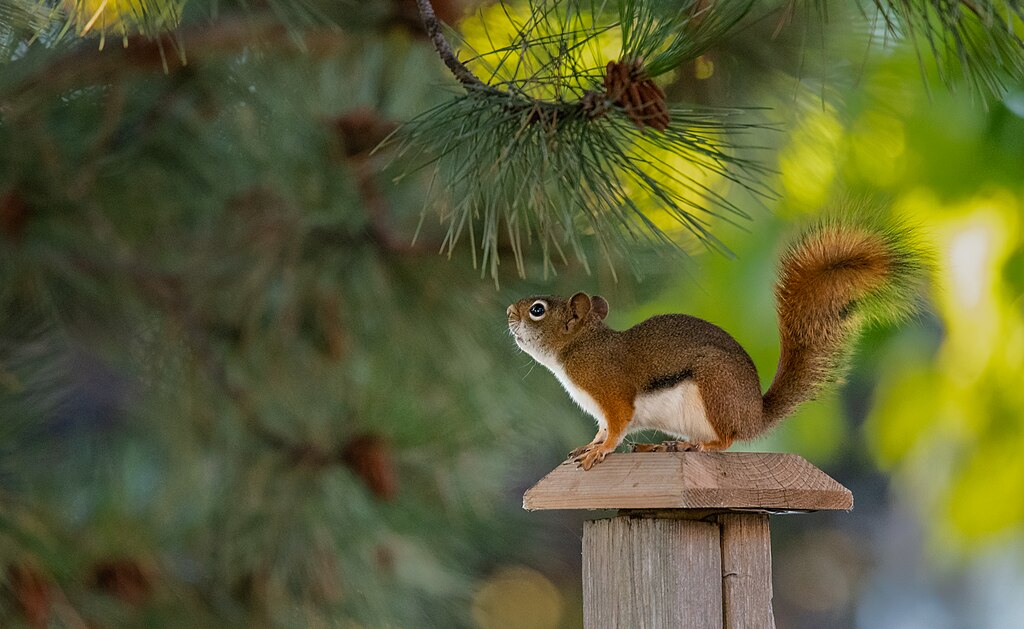
I’ve seen glimpses Reds from time to time, while hiking in various locations around the U.S., but during a camping trip on Philpott Lake in southwestern Virginia with my sweetheart last October, I had the chance to get to know a few of them a little better. Based on what I saw, they are certainly not shy.
Four or five of them were exploring the vacant campsite next to ours, searching for anything edible the human tenants may have left behind. When a morsel was found, it was transported to the picnic table to be consumed while taking in the view. Once that site had been scoured, the foragers made their way one by one to our site and closer to where I sat quietly in a folding lawn chair, watching them like a hawk.
Well… I guess it’s more accurate to say I was watching like a wildlife biologist. The Reds certainly didn’t have any trouble recognizing that I am not hawk, or any kind of threat. Especially once I tossed a few pieces of toast crust their way.
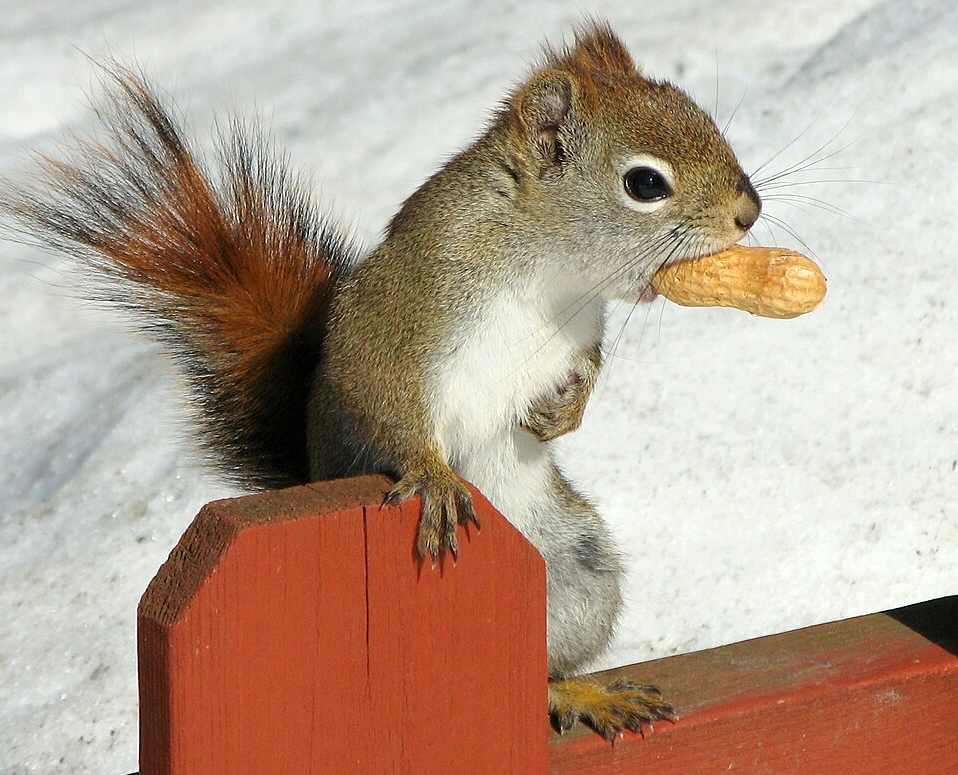
Reds are most commonly found in coniferous forests, and evergreen tree seeds are a favorite food. But these squirrels will stake out a homestead in a deciduous forest as well, and they don’t seem to care whether the trees are in a state park or a city park, a suburban backyard or school campus.
For a mammal who’s technically classified as a granivore (i.e., seed-eater), this species orders from a rather diverse menu that includes berries, bird eggs, acorns, sunflower seeds, peanuts, and even mice. Reds are known to really sink their teeth into shopping for groceries, tapping maple trees with their chisel-sharp incisors and then lapping up the sugary sap.
Reds also have a handy evolutionary benefit in the form of a gut microbiome with specific bacteria and fungi that equips these rodents with the ability to safely consume toadstool mushrooms that have poisonous or psychoactive properties, including fly amanita (Amanita muscaria) and panther cap (Amanita pantherina), as well as some species that are deadly for humans.
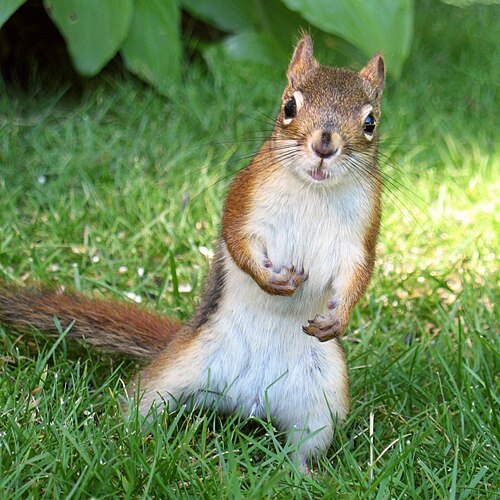
Reds are known to be highly territorial. Young squirrels may inherit some or all of their mother’s territory. If she’s not ready to hand over the deed then her offspring will need to disperse and create a new territory, or compete for a recently vacated territory.
Once squirrels who disperse from their natal homestead have a place to call their own, their next step towards insuring survival is to establish a midden, a place to stash surplus seeds, nuts, and other non-perishable foodstuffs. Reds believe food is worth fighting for, and they are NOT fans of sharing. They’ll protect their pantries from thieves, but they’re not above indulging in a bit of piracy themselves. Reds won’t hesitate to commandeer valuable resources, chasing birds and larger squirrels away from backyard feeders, a windfall acorn crop, or a campsite treasure trove of leftover Doritos, trail mix, cookie crumbles, granola, french fries, and peanut butter.

Reds don’t have many social interactions with one another beyond territory and resource defense… and the breeding seasons. In early spring (February—March) and then again in mid-summer (June—July), females leave their territories a few days before it’s time to to procreate and make their presence on their neighbors’ lands conspicuously obvious. It’s the squirrel equivalent to sneaking into the men’s room and writing your name and phone number on the wall, and you’d better believe the guys take note.
Sure enough, when that randy day arrives, the local lads congregate to compete for the lusty ladies’ attention by chasing them up and down and all around the neighborhood timber. It’s a Squirrels Gone Wild infomercial come to life. Red gals take to heart that old warning to not put all your eggs in one basket, so instead of one baby daddy they may have 4-16. Since squirrels are diurnal (active during daylight hours), when night falls everyone returns to their solitary home sweet homes to rest and recover and probably never see each other again.
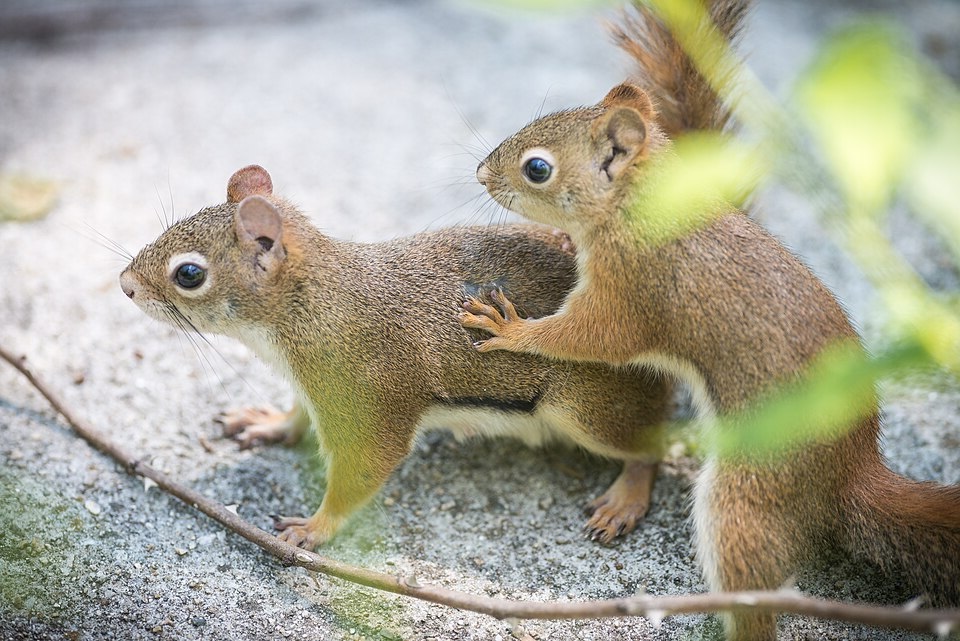
Except the females won’t be solitary for long. About one month later (31-35 days), one to five pink, hairless consequences will arrive in all the nests fashioned by those single Moms who wove grasses into the branches of trees or stuffed dried leaves into tree cavities. For the next 70 days each new Mom will lovingly keep those babies clean, fed, and warm, even for a while after they begin venturing out from the nursery at about 42 days of age. By day 125 the youngsters will have reached their full adult size and the Hunger Games begin.
It’s possible that what looks like red squirrel confidence is nothing more than bravado, given that only 22% of the annual reproductive output will live to see their first birthday. Reds may be lionhearted, but they’re still a rodent, and a small one at that. Most squirrels are classified as prey species even though they are also opportunistic omnivores who won’t pass up an opportunity to partake in animal protein when it becomes available, even if that protein is a cousin. Crows and ravens, hawks, owls, weasels, bobcats and lynx, foxes, coyotes, and wolves feel the same way about Reds… they’re not about to turn down a tasty and nutritious squirrel snack or a multi-course squirrel dinner.
Sometimes it’s a hard world for the little things.
In other words, sometimes it IS the size of the dog in the fight… or the fox, or the owl, or the squirrel. Audacity only gets you so far because at some point you will be called upon to back that attitude up with action. And yet, if sincere risk of peril is a prerequisite for valor, then I think my original assessment of American red squirrels is valid — they are bold, plucky, and more courageous than many creatures who are physically larger.
While they’re not always victorious in the battle for survival, I would argue that it’s still not the size of the squirrel in the fight, but the size of the fight in the squirrel that matters.
* This quote has been attributed to a diverse cast of characters, including my fellow Missouri native, Mark Twain (aka Samuel Clemens), President Dwight Eisenhower, University of Alabama football coach Paul “Bear” Bryant, Cincinnati Bengals running-back Archie Griffin, and poet Arthur G. Lewis, to name but a few possible bygone sages.
Life is better with Next-Life is better with Next-Door Nature—click the “subscribe” link in the lower left-hand corner of the footer and receive notifications of new posts! Have a question about wildlife and other next-door nature? Send me an email and the answer may turn up as a future blog post.
© 2026 Next-Door Nature — no reprints without written permission from the author (I’d love for you to share my work but please ask). Thanks to the following photographers for making their work available through a Creative Commons license: Gilles Gonthier, Mustang Joe, Gilles Gonthier, The Real Kam75, Gilles Gonthier, Eric Kilby, and Jakub Fryš.
 Next-Door Nature

_(52378473531).jpg)
.jpg)
.jpg)

.jpg)

Leave a comment