Feeds:
Posts
Comments
wildlife and roads, wildlife watching, wildlife habitat

Roads are both a blessing and a curse for wildlife (Photo: Colleen Greene, Creative Commons license)

.

Ever dreamed of going on a safari? Then fasten your seat belt, start the engine, and hit the road. Any road. I’ll bet you dollars to donuts—take the time to look and you’ll spy enough wildlife to satisfy, Bwana.

Sure, some of the creatures will be easier to spot than others… for the simple reason they’re no longer moving.  But I’m not proposing a road-kill road-trip. Trust me, the city streets, shady neighborhood boulevards, highways and byways offer plenty of opportunities for wildlife watching. Naturally, the species on display depend on the size of the road, its location, the season, time of day, and the speed limit.

wildlife and roads, vultures, wildlife watchingLet’s say your motoring down a divided highway, a conduit to and through the all-American suburbs. The big stuff (aka megafauna), such as deer, elk, moose, bears, and even coyotes, can be seen at 65+ mph (although not always in time to either admire or avoid them). Certain birds of prey, red-tailed hawks in particular, can be seen at both speed and distance due to their habit of hanging out high on handy utility poles to scout for snacks. Anything more petite will be visible only if it’s on the shoulder or trying to cross the road. Scavengers looking for a free lunch can be seen out on the open road day (crows, ravens, vultures) and night (opossums, coyotes). That meal ticket can quickly turn the diner into dinner for someone else… and so on.

wildlife and roads, wildlife watching, groundhogBeyond mowed blacktop borders, in the woods and taller grasses, you’ll find rabbits, foxes, raccoons, skunks, and groundhogs. Based on my own non-scientific observation, to improve your chances of seeing these meso- (medium-sized) species as well as small but brightly colored male songbirds in situ you’ll have to ease up on the gas pedal and let the speedometer drop to 35-45 mph, tops.

A bicycle (or even a horse if you have access to one) would probably set the right pace for a rider to notice mice and voles, lizards, turtles, frogs and toads, as well as female songbirds (who tend to have less flashy wardrobes than their ready-for-the-disco menfolk). The truly diminutive critters—insects, spiders, snails and slugs—are hard to spot at more than arm’s length so it’s best to set off on foot and plan for a leisurely pace if spineless quarry is your goal.  A general rule: the slower you go, the more you’ll see—that’s what makes the backroads more appealing for this kind of trip than a superhighway.

In poetry, novels, song, and cinema people often speak of the allure and romance of roads—the ones that calls us, the ones less traveled, the ones that go on forever, choosing between high ones and low ones. Wild animals rarely have access to books and mp3 players and RedBox kiosks, though, and I’ve never found them to be all that interested in popular culture… so what’s the attraction?

To build a road through a previously undeveloped area, the first thing that happens is clearing a swath of the existing plant community, be that trees and shrubs or grasses or cacti. Once the project is completed (or even while it’s still in progress) new plants begin to colonize the bare soil, creating a plant community that’s different from the surrounding landscape along with an edge where new and old meet.  Disturbing the soil stimulates the germination of seeds that may have sat dormant for a long time waiting for the right conditions. Soil may be brought in from somewhere else as part of the construction process along with seeds from plants that are completely novel in this setting.

wildlife and roads, wildlife watching, wildlife habitatSince the plants predict what kind of animals will be found in any ecosystem, the new habitat creates opportunities certain wildlife species will exploit… but in most cases it won’t be the species that were living happily in the pre-construction habitat. Edge species will colonize the area, often using the right-of-way as a travel corridor before and after the road is completed. Some organisms will hitchhike to their new home on and in the bodies of larger animals or even motor vehicles. Birds, bats, and flying insects will drop in from above. Wild things are always jockeying for space and there’s no such thing as a vacant lot in nature—at least, not for long.

wildlife and roads, wildlife watching, pronghornMake no mistake—roads are a significant cause of habitat loss and their presence is detrimental to many types of wildlife. For others, thought, the resulting edge provides exactly what they need to thrive. This includes our most familiar next-door nature species. In fact, the reason blue jays, robins, white-tailed deer and other edge-loving species are so common in human communities is because Homo sapiens is also an edge-loving species. Our roads are simply one very conspicuous example of that fact.

The natural world is never static; it’s always in flux and each day there are new winners and losers.  Are roads good or bad for wildlife? It depends on the species. But there’s no doubt they are a boon for wildlife watchers.

.

Life is better with Next-Door Nature—click the “subscribe”  link in the upper right-hand corner of this page and receive notifications of new posts!

© 2012 Next-Door Nature—no reprints without written permission from the author (I’d love for you to share my work. Just ask first.). Thanks to these photographers for making their work available through a Creative Commons license: Colleen Greene (black bear); e_monk (black vulture); Matt Reinbold (groundhog); MoDOT Photos (edge habitat); Allan Harris (pronghorn).

wood duckling

Wood ducklings are natural-born paratroopers (Photo: Winnu, Creative Commons license)

.

What has webbed feet, waterproof feathers, a broad bill… and nests in a tree? Don’t let that last clue fool you. While it’s true most ducks build their nests on the ground, the wood duck (Aix sponsa) aims a little higher.

wood duck pair by Rick Leche, Creative Commons licenseThis species is easy to recognize, at least as adults. The male is a dandy dabbler, sporting a glossy iridescent green head, a white chin, and a speckled russet cravat. The female’s wardrobe is a bit more subdued, but her large, white teardrop-shaped eye patches are unique among North American ducks.

Wood duck hens prefer to nest in a tree cavity, but they’ll accept a custom-made nesting box if it’s positioned correctly—you know what the Realtors say, “Location, location, location.” After hatching, ducklings spend about 24 hours in the nest while their baby down dries. The young are precocial, meaning they can walk, swim, and feed on their own—but first they have to get out of the tree house. And that first step is an 8–30’ doozy!

Momma flies down to the ground and then calls for her offspring to follow. But the hen has fully developed, fully feathered wings. There’s nothing aerodynamic about a one-day old duckling. Yet, one by one, they use their sharp claws to scramble up from the nest floor to the entrance, balance on the edge, and…. LEAP!

Fluttering useless wing stubs they fall like fluffy stones and land with a thump on their sternums. They shake it off and wait for the rest of their siblings to take the plunge, then the whole family heads off to join Dad at the nearest body of water. Foolhardy as this approach to child-rearing may seem to us, it’s worked very well for generations of tree-nesting ducks.

wood duck hen and ducklings by Ducklover Bonnie, Creative Commons licenseThat is, until they had to share the woods with people. Mother duck may mistake a swimming pool for a pond, and while she can easily clear a tall fence to find wilder waters, her youngsters can’t. However, they’re drawn instinctively to the safety of water. Homeowners who find themselves hosting an impromptu waterfowl pool party should consult with their friendly neighborhood wildlife rehabilitator for advice. Wood ducklings are shy creatures, and the wrong kind of help can send them into a state of shock, or worse.

Delicate? I guess that’s one way to look at it. Who am I to judge, though? I’m not afraid of heights, but if I were a duckling making that jump from nest to terra firma, I’d be in shock before I was halfway down.

.


..

.

Start your day with a little Next-Door Nature—click the “subscribe”  link in the upper right-hand corner of this page and receive notifications of new posts!
© 2011 Next-Door Nature—no reprints without written permission from the author (I’d love for you to share my work. Just ask first.). Thanks to these photographers for making their work available through a Creative Commons license: Winnu (duckling); Rick Leche (male and female); Ducklover Bonnie (female with ducklings).

red-bellied woodpecker on fence (Photo: Brian Peterson, Creative Commons license)

Robert Frost said, “Good fences make good neighbors” but embattled red-bellied woodpeckers must find other ways to protect their territories. (Photo: Brian Peterson, Creative Commons license)

 .


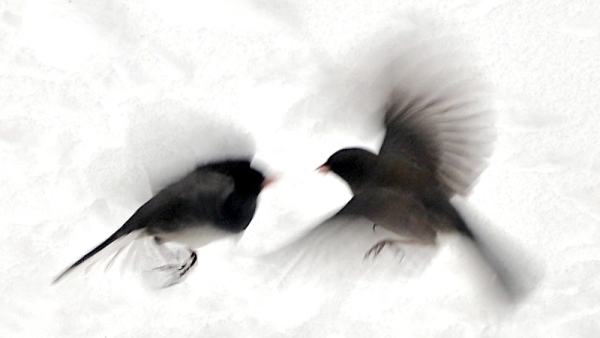
Last Sunday morning I unexpectedly found myself sitting ringside for a brief but furious brawl. Two male red-bellied woodpeckers (Melanerpes carolinus) were having a boundary dispute that started with an argument over some shrubbery then escalated into a full-on aerial assault. Colliding mid-air, they grasped one another by the feet and were so intent on punching, pecking, and plucking, the adversaries flew thoughtlessly over the nearby road directly in front of my car. Luckily, I was making my way slowly along the otherwise quiet suburban street, so I was able to stop and watch.

With my windshield serving as an impromptu HDTV, the smackdown aired for all of 45 thrilling seconds and then, as if in response to a referee’s break command… it was all over.  Each fighter retreated, shouting insults over his shoulder as he returned to his corner.

male and female RBW by Jason Paluck, Creative Commons licenseRed-bellied woodpeckers (let’s just shorten that to RBWs, shall we?) are a medium-sized bird—just over 9” (24 cm) from chisel beak to stiff tail tips with a 13-16” (33-42 cm) wingspan. Like many North American woodpeckers, they wear a black-and-white houndstooth jacket, but their bright red Mohawk (males sport a full forehead-to-neck cap while females wear an abbreviated version) sets them apart. It’s also the reason these birds are so often misidentified as the similar-sized red-headed woodpecker (Melanerpes erythrocephalus), although once the difference is pointed out the mistake is rarely repeated. RBWs take their name from a subtle scarlet stain on their buffy belly.

red-headed vs. red-bellied woodpeckers by Laura Gooch and Jason Paluck, respectively (Creative Commons license)Year-round residents in U.S. wetlands, river bottoms, woods, and wooded suburbs from the Midwest east to the Atlantic coast, RBWs are omnivorous, consuming all manner of  insects, nuts, seeds, sap, and fruit. They store surplus food in various nooks and crannies and, since they don’t migrate, their larders come in handy during winter. This species employs gender-specific foraging strategies—males search for sustenance primarily along bole while females spend the bulk of their time on the boughs.

Biologists don’t often venture out on a limb to officially identify any non-human behavior as play, but I’ve notice the profession has loosened up a bit on this issue over the past decade or so, thankfully. One example of this trend was a description of RBW behavior I read recently. This species will periodically engage in swift, nimble, and unpredictable forest flights, complete with many direction changes to dodge trees, and accompanied by constant excited chatter. The author of this resource was quick to explain that the activity probably has a practical application in that it helps youngsters practice evasive maneuvers that would come in handy should predators be lurking about. However, and surprisingly, the expert also admitted the birds seemed to be having fun.

male red-bellied woodpecker in nest (Photo- Frederick Knapp, Creative Commons license)RBWs are monogamous—for the extent of a breeding season, that is (so perhaps it would be more accurate to say they are serial monogamists)—and both are actively involved in raising young.  They nest in hardwood and pine trees, along with the occasional fence post, by excavating a cavity or stealing one from other birds. What goes around comes around, though—or so says a timeworn adage; RBWs often lose their precious nest holes, in turn, to European (aka common) starlings (Sturnus vulgaris).

Assuming the pair can hang on to their home, the female lays two to six white eggs on a cushion of wood chip construction debris and incubates them for 12 days. The hatchlings are altricial, meaning they begin their lives naked, blind, and helpless. They don’t waste any time growing up, and are ready to leave the nest for a first tentative flight when they are 24—27 days old. Depending on the region, the adults may raise from one to three broods in a season.

red-bellied woodpecker at feeder (Photo: ehpien, Creative Commons license)Defending the homestead is a top priority during the child-rearing seasons, especially if the ‘hood includes a well-tended feeder (a gold mine for species able to digest seeds or suet). Even though most bird nestlings can’t tolerate seeds and need a diet composed largely of insects, when Mom and Dad can grab a high-calorie meal from the avian equivalent of a fast-food restaurant, they have extra time to hunt for the more illusive foods their offspring need to develop properly.

Since RBW territories range from 3 to 39 acres protecting the perimeter is far from a simple task, especially when feeding yourself and your family is a full-time job. So, naturally, breaches occur… but everyone trespasses and is trespassed against.  Border skirmishes are common but they rarely result in bloodshed. Research tells us that’s due, in part, to the fact that the intensity of defense behavior tends to decrease as an animal moves away from the center of its territory. Put another way, property rights become less important the farther you are from home. In most cases, both combatants throw in the towel long before there’s a knock-out.

.

There’s nothing quite like finding a little Next-Door Nature in your email inbox—click the “subscribe”  link in the upper right-hand corner of this page and receive notifications of new posts!
© 2012 Next-Door Nature—no reprints without written permission from the author (I’d love for you to share my work; all you have to do is ask). Thanks to these photographers for making their work available through a Creative Commons license: [starting from the top] Brian Peterson (on the fence); Jason Paluck (male & female; red-bellied); Laura Gooch (red-headed); Frederic Knapp (in nest); ehpien (rbw @ feeder).

Hops-itality

pacific tree frog (photo: jacki dougan, creative commons license)

Frogs, including this Pacific tree frog, could use a little help as they try to survive in the 21st Century (Photo: Jacki Dougan, Creative Commons license)

.

Fifty years ago, Rachel Carson asked the world to consider a simple question: imagine springtime without birdsong.

Silent Spring addressed an unlikely subject for what was to become a best-selling book—the effect of DDT and other pesticides that persist in body tissue, becoming more and more concentrated as they move up the food chain (a process known as biomagnification). Yet nearly everyone could easily understand that their own quality of life would be diminished should they step outside one sunny May morning to find the dawn chorus had been replaced with a deafening stillness.

green treefrog (Photo: sarowen, Creative Commons license)Thanks to Carson’s courageous stand—and the subsequent public outcry—songbirds and other avian species dodged a bullet.* Now there’s another set of wild voices in the spring choir who could use a hand—the amphibians.

More specifically, frogs.

There are now over 1,800 threatened amphibian species. At least 168 species have gone extinct in the last two decades due to factors such as habitat loss, water pollution, disease, climate change, and invasive species. Additionally, many areas in the U.S. have recently experienced severe drought, and England is currently experiencing its worst drought in decades.

Many frog species depend on ephemeral (temporary) water sources for breeding since they don’t support fish that would eat the eggs and tadpoles. If the ephemeral pools dry up before the young amphibians have time to metamorphose, or if there isn’t enough rain to create pools in the first place, it can result in a missed generation… and a fragile future for frogs.

Poison Dart Frog Sitting on a Leaf (Photo: MoleSon2, Creative Commons license)Kermit the Frog spoke from experience—it isn’t easy being green… or yellow, or red, or black, or blue.

Frogs are essential to the health of wetland, riparian, and coastal ecosystems. Tadpoles feed on algae, preventing blooms that can reduce oxygen levels. Frogs consume millions of insects each year, including mosquitoes and ticks carrying diseases that threaten the health of humans, their companion animals, and livestock. A wide variety of wild mammals (raccoons, opossums), birds (herons, hawks, geese), and reptiles (snakes) rely on frogs as part of their diet.

April 28th was the 4th Annual Save the Frogs Day, established to raise awareness and funds for amphibian conservation. Since many frog species are comfortable living in cities and suburbs, I thought I would pass along suggestions for homeowners who would like to offer some hoppin’ hospitality, courtesy of yesterday’s event organizers:

1.    A Wet Welcome Mat

Fall and spring are the best times to create a permanent oasis for frogs. Kits are available at many garden and home improvement stores, or simply use a container or dig a hole that is deep enough (at least 1 foot at one end) and line it with sand or a flexible plastic liner before adding water.  Keep in mind, you must provide a sloped ramp so the frogs can get out easily.  Slope the liner or build one out of rocks to gradually allow the frogs to get to ground level or out of the pond. (Some nurseries also have floating devices for swimming pools that can allow amphibians who might jump in a way out.)

Don’t clean the water. In fact, add floating plants such as lily pads or leaves to provide cover. Refill slowly and carefully if water levels get low.

Don’t put fish in your pond, as they will munch on your tadpoles and frogs.

2.    Shade & Shelter

Place your pond in a shady spot, preferably surrounded with native plants to attract a tasty bug feast of ladybugs, bumblebees, and other pollinators to also help beautify your yard. You can stack some rocks or turn over a half of a flowerpot beside the rim of the pond to give your frogs a place to sit and eat their lunch as it flies or crawls by.

glass frog (Photo: Josiah Townsend, Creative Commons license)3.    Go Organic

Don’t use pesticides or weed killers. Amphibians absorb water—and any chemicals in it—through their skin. Pesticides and weed killers can run off from land into water and can be lethal to amphibians. Certain weed killers also can alter hormones, changing male frogs into females and reducing the potential of frogs to perpetuate thriving populations.

4.    Patience, Grasshopper

Don’t be tempted to relocate frogs from other areas or stock your pond from pet stores. You may introduce diseases or invasive species and domestically raised frogs will not necessarily adapt to wild habitats. If you build it, frogs will come.

5.    Look & Listen

Become a frog watcher. You will appreciate these wonderful animals more if you can see them in action, and you can help their conservation in the process. The National Wildlife Federation’s Wildlife Watcher program allows citizen scientists to contribute to a growing database of North American wildlife, learn about the animals living in their region, and build a printable checklist of sightings. 

.

* Although the focus of this post is frogs, wild birds still face many challenges and threats to their long-term survival. You can check out one such hazard here. Others will be addressed in upcoming NDN posts.

.

Life is better when you have Next-Door Nature—click the “subscribe”  link in the upper right-hand corner of this page and receive notifications of new posts!
© 2012 Next-Door Nature—no reprints without written permission from the author (I’d love for you to share my work; all you have to do is ask). Thanks to these photographers for making their work available through a Creative Commons license: [from top to bottom] Jackie Dougan (Pacific tree frog in rose); sarowen (green treefrog); Sascha Gebhardt (poison dart frog); ucumari (bullfrog); Josiah Townsend (glass frog).
common brushtail possum (Photo: David Midgley, Creative Commons license)

Common brushtail possums know how to work the cute (Photo: David Midgley, Creative Commons license)

..

Consider, if you will, the sartorial importance of tail attire.  To bare, or not to bare… that is the question.  The answer might seem to be of little consequence, but for marsupials living in cities and suburbs some strategically placed fur can make all the difference.

That’s because naked tails make people nervous. I blame this bias on the Black Death. Of course, now we know the true culprit in that famous pandemic of 1347 was not the rat, but the infected fleas that hitched a ride on those hapless rodents. Since standards of human hygiene at the time were rather… haphazard, shall we say, there were plenty of opportunities for the insects to hop onto a handy human. We may not remember why rodents make us uneasy but the bias remains to this day.

How else do you square our acceptance and even advocacy of squirrels and chipmunks, for example, with our abhorrence of rats and mice? As Carrie Bradshaw of Sex and the City fame so wisely observed, “A squirrel is just a rat with a cuter outfit.” Clothes make the man and the mammal.

The same could be said of the common brushtail possum (Trichosurus vulpecula) and its cousin the Virginia opossum (Didelphis virginiana). Both are omnivorous marsupials of similar size and weight. However, the former has a hirsute terminus while the latter’s prehensile appendage is as furless as a snake. Brushtails are the source of much frustration among Aussie homeowners who, nonetheless, demonstrate great fondness for this plush-toy wannabe. The North American model does not enjoy a similar degree of affection from its human neighbors (to put it mildly).

Is this inequity mere coincidence? I think not—if you ask me it’s blatant bare-tail bigotry!

Personally, I find the adult Virginia opossum to be a handsome creature and their young ones winsome and endearing.  But—let’s face it—we only have one marsupial here in the U.S., so there’s no competition for best in show.

It’s a different story in Australia, where possums* and the closely related gliders account for approximately 30 of the continent’s 140 marsupial species. Brushtails are attractive animals by any aesthetic standard, with thick, luxurious fur that ranges in color from silver-gray to cream, brown, black, and even red, depending on the subspecies.

As the name implies, the common brushtail is a familiar resident along much of coastal Australia including the major metropolitan areas such as Sydney, Melbourne, Brisbane, and Perth. Suited to a wide variety of habitats, from rainforests to semiarid regions, this semi-arboreal (tree-dwelling) possum has adapted readily to urban life, trading traditional tree cavities for a home under the eaves.

brushtail mother and child (Photo: mugley, Creative Commons license)Brushtails can breed at any time during the year, but there are two peak seasons—from September to November (southern hemisphere spring) and from March to May (Australian autumn). Following a 16-18 day gestation, the female gives birth to a single blind and extremely underdeveloped child who scrambles unaided up to her pouch. Once inside, it will attach to a teat and remain there for another four or five months, after which it will either stay home at the den while Mom goes out to forage or ride along on her back, sharing any groceries she finds while learning what and where to eat. Male possums are not involved in child-rearing.

Human or non-human—if you want to succeed in the urban jungle, it sure doesn’t hurt to have a pretty face. Brushtails have large ears perched on a rounded head, a pink nose and dark liquid eyes… and they don’t seem at all shy about working their assets to full advantage. They may have learned a thing or two from eastern gray squirrels (Sciurus carolinensis), introduced to Australia sometime between 1900 and the 1930s—there’s just something about watching a furry creature nosh while holding the treat with two hands that people find irresistible, apparently, because hand-feeding fruit treats is a popular past-time.

attic brushtail (Photo: play4smee, Creative Commons license)There’s a down side to this Down Under hospitality, though. With warm, dry sleeping berths and plenty to eat, brushtails haven’t found it necessary to step lightly on the Earth… or in the attic either.  Their heavy-footed nocturnal comings and goings and loud vocalizations are responsible for plenty of sleepless nights and lost tempers. Brushtails often wake the neighborhood dogs as they wander through the neighborhood via utility poles and fencing, creating the same kind of hard feelings directed at Virginia opossums on the other side of the globe, for the exact same reason.

When not snacking on handouts from the produce section they will munch on magnolias, roses, and other selections from the flower garden as well as on eucalyptus and other trees—Aussies do not consider this one of the brushtail’s more appealing qualities. And, like their northern hemisphere kin, brushtails will dumpster dive and help themselves to the back porch pet food smorgasbord, resulting in much hair-pulling and teeth-gnashing by Homo sapiens.

Yet, somehow, brushtails seem largely immune to the vilification of their less charismatic cousins. To the cute (and furry-tailed) go the spoils, I guess—it’s an all too familiar tail and decidedly unjust. But as my mother (and probably yours too) always said, “Who told you life is fair?”

One thing’s for sure, it wasn’t a ‘possum.

[This one is for Barb at Passionate About Pets and People. Thanks for your support and encouragement!]

.

* Although both are marsupials, it is commonly accepted that the Americas have opossums (colloquially referred to as ‘possums) while Australia has possums. Yes, it is confusing. No, I don’t know why or how this came to be. Even in the 21st Century there remain great unsolved mysteries.

Start your day with a little Next-Door Nature—click the “subscribe”  link in the upper right-hand corner of this page and receive notifications of new posts!
© 2012 Next-Door Nature—no reprints without written permission from the author (I’d love for you to share my work. Just ask.). Thanks to these photographers for making their work available through a Creative Commons license: David Midgley (brushtail eating an orange); mugley (mother and baby); and play4smee (attic brushtail).
eastern bluebird 2 by Jason Matthews, Creative Commons license

A male Eastern bluebird personifies happiness, whether he's happy about it or not (Photo: Jason Matthews, Creative Commons license)

.

Happiness is a shy little bird. Hiding from sight in life’s nooks and crannies, impossible to find if you look but then it darts out and lands on your shoulder just when you least expect it. It sidles up beside you like a pickpocket on a crowded street, soft and silent as wings brushing against your lapel. Hardly even noticed until something or someone causes it to flush in a flurry of feathers from beneath your jacket, taking with it a sizeable chunk of your heart. Try to grab hold as it flies away and the thief proves as elusive as dreams upon waking, slipping through your fingers like a shadow, like quicksilver.

The concept of happiness has been flitting in and out of my brain and my life for a couple of weeks now. My birthday earlier this month may have provided the initial impulse. This wasn’t a major milestone year, I’ve got too much on my plate these days to leave much room for cake, plus I’m living in a new town and don’t know many people yet… but I did take a little time to acknowledge the day and do some thinking. December 31st may be the culturally accepted time to contemplate one’s short- or long-term past and make plans for the year to come, but my inner-Pagan knows the vernal equinox is the true start of a new trip around the sun. Besides, I’m not much for following the crowd. I was the kind of kid who would disassemble all the board games in the house, shuffling the tokens and cards to make up my own game with my own rules.  So I like the idea of a personal calendar that begins in April, and a personal New Year’s Eve for reviewing said year is also appealing. Later that same week, two unanticipated events provided additional incentive to ponder the nature of happiness.

Then again, maybe I’ve had happiness on my mind because the bluebirds have returned.


mountain bluebird pair (Photo: freeopinions, creative commons license)

Mountain bluebird pair

This year, I’ve been watching eastern bluebirds (Sialia sialis) each morning while my terrier-boy practices his soccer moves on a squeaky red rubber ball. At other times in my life, while living in other parts of the U.S., I’ve watched spring come to town on the wings of both western and mountain bluebirds (S. Mexicana and S. currucoides, respectively).  A feathered piece of sky flashing across the landscape on shallow wing beats can lift a heavy heart and lighten my mood.

Members of the Turdidae family (aka thrushes), bluebirds are related to that other famous spring harbinger, the American robin (Turdus migratorius). All three Sialia species are easy to spot and identify even though, as fruit and insect eaters, they don’t visit seed-filled feeders. The males are clad in some combination of blue with red and/or white; their mates wear less conspicuous versions of the same plumage.

Efforts to ensure this popular bird’s continued breeding success began with the recognition that they were struggling in the face of competition from introduced species such as the European starling (Sturnus vulgaris) and house sparrow (Passer domesticus), as well as reduced access to nesting habitat. Happily, by building, installing, monitoring, and maintaining special nest boxes, handy men and women across the U.S. have proven crucial to the species’ recovery.

Bluebirds have long symbolized cheerfulness, health, prosperity, and renewal, although I’m not sure why. Their lives are far from easy or free of conflict. Males battle over breeding territories, chasing one another at breakneck speeds, grabbing each other by the feet in mid-air, smacking opponents with their wings as they try to pull each others feathers out with their beaks. They must defend nest cavities or boxes from a host of other birds, many of which are substantially larger. Once a nest site has been established, a mated pair may produce 2-4 broods per season—a task that requires foraging non-stop during daylight hours to find enough food to keep themselves and their offspring fed. If that were not challenge enough, bluebirds undertake an exhausting and hazardous migration of up to 2,000 miles each autumn and spring.

female eastern bluebird by Patrick Coin, Creative Commons license

Female Eastern bluebird

Despite these hardships, some sources claim the connection between blue birds and happiness is global (albeit focused on bird species indigenous to each country or continent). One thing is certain—the notion, however it began, has been perpetuated by Hollywood and on the radio. I have to wonder if any other bird has been as popular with songwriters and singers, starting with  Bluebird of Happiness, a hit song in the early 1930s that may have ushered this phrase into the popular vernacular.  Judy Garland probably helped things along when she sang of bluebirds flying Somewhere Over the Rainbow. For those who like both their birds and their grass blue, there’s Lester Flatt’s Bluebirds Singing For Me. Paul McCartney, Buffalo Springfield, Bonnie Raitt and, more recently Christina Perri and Adam Green all feature bluebirds on their playlist. Sara Bareilles’ poignant Bluebird tells of a kind of migration, but my own favorite blue bird tune, Birdhouse in Your Soul by They Might Be Giants, transports me to a happy scene, sitting with my sweetheart at the kitchen table of a remote lake house in a faraway forest.

Emotions can be tricky to articulate and color can help paint a clearer picture. I get that. If a friend says she’s in the pink or he’s green with envy, you know the score even without the details (although you may still want to hear them). Red is, of course, the color of both anger and passion (maybe that’s why one so often leads to the other). Blue is happiness—at least, that’s what a little bird told me. But is it? If I say I’m feeling blue you’re not likely to picture me in your mind’s eye singing in the rain ala Gene Kelly.

western bluebirds by Julio Mulero, Creative Commons license

Western bluebirds

How did a single color come to represent both sides of the spectrum, sadness and joy? I wish I knew, but I’m not sure it matters in the long run. I do know this: happiness prefers an open palm to an iron grip. It doesn’t do well when caged; like a wild bird, it needs to be free to come and go as it chooses. A full life requires both kinds of blue plus all the other colors and creatures, winter and spring, parting and reunion. If you want to have happiness in your life you must be willing to risk losing it, trusting that it will return as surely as bluebirds in April. That’s the trade-off, the price you pay for the flutter of wings in your heart and stomach.

But worth every penny.

.

There’s nothing quite like finding a little Next-Door Nature in your email inbox—click the “subscribe”  link in the upper right-hand corner of this page and receive notifications of new posts!
© 2012 Next-Door Nature—no reprints without written permission from the author (I’d love for you to share my work; all you have to do is ask). Thanks to these photographers for making their work available through a Creative Commons license: Jason Matthews (male Eastern bluebird);  freeopinions (mountain bluebirds); Patrick Coin (female Eastern bluebird); Julio Mulero (Western bluebirds).

Hitchhikers

Urban living for Sadie the Squirrel by Tom Fischer Photography, Creative Content license

.

Add another accomplishment to my resume as official wildlife guru and animal-vehicle biologist for NPR’s Car Talk—the 14th most popular radio show on the U.S. airwaves and the 6th most popular if you exclude shows that feature a some kind of shock-jock (and that, I’m sure hosts Tom and Ray Magliozzi would agree, is pretty shocking).

No April fooling. In addition to answering questions for their Wildlife & Your Car FAQ page and helping a Wyoming caller understand why horses consider the hood of her car an appropriate alternative to chewing gum, I’m now a guest blogger on the site as well.

Wrangers Escort Gremlins shares some listener tips for preventing and humanely discouraging packrats and other rodents from turning your engine compartment into an apartment and an ingenious method for convincing snakes (pet pythons as well as serpent strangers) to vacate the interior of your preferred form of motorized transportation. Why wait? Click and Clack on over to the blog site before you find yourself staring into a pair of beady eyes or on the receiving end of a forked-tongue raspberry. And while you’re there, feel free to add comments on my post and offer any tips you may have for dealing with vehicle-wildlife conflicts. You never know… maybe your advice will be featured further down the road.

.

There’s nothing quite like finding a little Next-Door Nature in your email inbox—click the “Sign me up!”  link in the upper right-hand corner of this page and receive notifications of new posts!
© 2012 Next-Door Nature—no reprints without written permission from the author (I’d love for you to share my work; all you have to do is ask). Thanks to Tom Fischer Photography  for making his  work available through a Creative Commons license.
Follow

Get every new post delivered to your Inbox.

Join 97 other followers