Feeds:
Posts
Comments

Archive for the ‘turtles’ Category

next-door nature, urban wildlife, fence lizard

Everyone, even fence lizards and other ectothermic creatures, are feeling the heat these days (Photo: Bandelier National Monument, Creative Commons license)

.

Temperatures across the southern half of the U.S. are soaring into triple digits, so I was trying to think of creative solutions to beat the heat when it hit me—why not become cold-blooded!

next-door nature, urban wildlife, fox squirrelAlas, my brain must have overheated. Once air conditioning allowed a cooler head to prevail I realized that what seemed like a brilliant idea while baking beneath a blazing sun is absolutely, completely, utterly impossible… and not simply because mammals cannot will themselves to undergo metamorphosis.

You see, technically there’s no such thing as a cold-blooded animal (unless you’re speaking metaphorically about someone who lacks emotion or empathy).  Or a warm-blooded animal, for that matter. Both terms are shorthand for the ways in which body temperature (aka thermophysiology) is controlled in different types of organisms.

Most mammals and birds are classified as endotherms (Greek: endon = within; thermē = heat). For these critters thermoregulation is an inside job, primarily by way of metabolic processes. Under extreme environmental next-door nature, urban wildlife, sunbathersconditions some physical mechanisms come into play, but not solar energy (at least, not directly). If the mercury plummets and the body’s core temperature begins to drop, muscles shiver to create warmth; if the core temperature starts to rise the body perspires to cool via evaporation. No sweat glands? Pant like a dog… or birds. All evidence to the contrary, since humans are mammals, swimsuit-clad sunbathers dozing in rows on a beach or poolside with icy drinks standing at the ready are, in fact, capable of maintaining a relatively constant body temperature.

next-door nature, urban wildlife, gray treefrogWhen an animal’s body temperature is strongly influenced by ambient conditions it’s an ectotherm (Greek: ektós = outside). Fish, amphibians, reptiles, and invertebrates rely on external heat sources to get their juices flowing, especially during the chillier seasons or cooler times of day. That’s why these animals can be seen basking on rocks, roads, and any other warmth-radiating surface. Then, when they can’t stand the heat they get out of the kitchen, retreating into shade, water, or underground to cool off (Sound familiar? We really are more alike than different).

Take-home message: mammals and birds are endotherms; invertebrates, fish, amphibians, and reptiles are ectotherms.

Except when they aren’t.

It’s the exceptions that make the rule, right? Let’s begin with the usual ectotherm suspects. According to one source, 2% of invertebrates are endothermic. Regrettably, the informant failed to name names but, in spite of the fact that spineless animals are not my strong suit, I did managed to chased one down—snails and slugs (Oops, that’s two… and “chased” may be overstating things).  Fish, being vertebrate species, are my regular beat so I can state with certainty that billfish (e.g., sailfish, marlins), tuna (Scombridae), one family of sharks (Lamnidae, including makos and whites), and one species of mackerel (Gasterochisma melampus) are endothermic… at least to some degree. I’ve yet to find a reliable report of an endothermic amphibian, but among the reptiles sea turtles exhibit both ecto- and endothermic traits.

next-door nature, urban wildlife, echidnaMoving along to the endothermic exceptions… Hummingbirds (Trochilidae), swifts (Apodidae), and common poorwills (Phalaenoptilus nuttallii) all experience periods of lower body temperature and metabolic rate; therefore, some biologists argue they have ectothermic traits. Additionally, there are mammals—certain rodents, a couple of lemurs, and many bats—that enter hibernation or estivation in response to low temperatures or drought, respectively. Then there’s the echnidna (Tachyglossidae), a “primitive” mammal from Australia that’s an ectotherm eleven months of the year and an endotherm during the month when it lays its eggs (Yes, eggs. If you like rule-breakers Australia is your Mecca. In the interest of time and space, though, we’ll have to save monotremes for another day).

What I’ve presented above is a fairly simplistic description of thermophysiology.  Why stop there? Because a more thorough treatment would require a good deal of nuance and a complicated discussion of sub-categories, not to mention a stiff drink (the current temperature is 99°F and rising—make mine a frozen margarita).  But since it’s so hot I’ll go ahead and venture past a toe in the water… up to my knees, but no further.

next-door nature, urban wildlife, elephant shrewOne subset of the endotherms are tachymetabolic (Greek: tachy = quick), organisms with a consistent and extremely high metabolic rate. Shrews (Soricidae) are a perfect example—diminutive beings with massive appetites, their metabolic rate is at least five times that of similarly sized ectotherms. Being able to snack non-stop and still rock a bikini probably sounds too good to be true. It is. Finding a constant supply of calories without access to fast food and grocery stores is no picnic. Bradymetabolic (Greek: brady = slow), which could easily be mistaken for bipolar disorder, is no bed of roses either. These organisms swing wildly between a high (when active) and low (when resting) metabolism, usually based on either external temperatures or food availability. (If you think someone else has got it better, rest assured you probably don’t know the whole story.)

As biologists refine our understanding of how bodies work, language evolves and once popular terms like cold-blooded fall from favor. Popular stereotypes suggest otherwise, but scientists are not completely immune to trends. When I was an undergrad, for example, the preferred word for organisms influenced by changes in ambient temperature was poikilotherm (Greek: poikilo = varied, irregular). Although still useful for making distinctions between types of ecotherms, the term is used less frequently now and may be on it the way out.

next-door nature, urban wildlife, crocodilesC’est la vie. Styles change, in both the lab and on the beach (Thankfully. I’m old enough to remember when Speedos were all the rage in men’s swimwear). I’d be willing to bet, though, that most Earthlings won’t give up sun worship any time soon. Chillin’ in a sunbeam feels too good, whether you need it or not (at least as long as there’s a pool nearby).

.

Start your day with a little Next-Door Nature—click the “subscribe”  link in the upper right-hand corner of this page and receive notifications of new posts!
© 2012 Next-Door Nature—no reprints without written permission from the author (I’d love for you to share my work. Just ask first.). Thanks to these photographers for making their work available through a Creative Commons license: Bandelier National Monument (sunning fence lizard); Michael V. Flores (fox squirrel cooling down); Nick Papakyriazis (sunbathers); geopungo (gray treefrog); BohemianDolls (elephant shrew); and Jess Loughborough (basking crocodiles).

Read Full Post »

wildlife and roads, wildlife watching, wildlife habitat

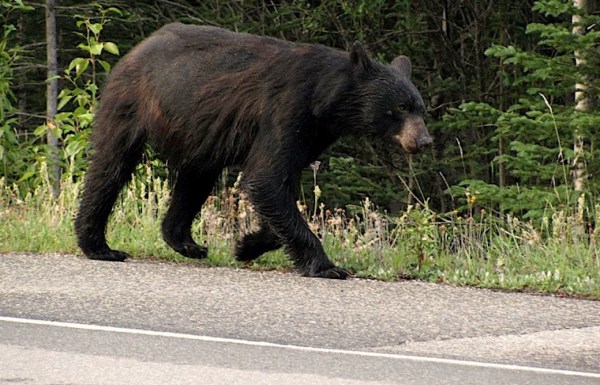
Roads are both a blessing and a curse for wildlife (Photo: Colleen Greene, Creative Commons license)

.

Ever dreamed of going on a safari? Then fasten your seat belt, start the engine, and hit the road. Any road. I’ll bet you dollars to donuts—take the time to look and you’ll spy enough wildlife to satisfy, Bwana.

Sure, some of the creatures will be easier to spot than others… for the simple reason they’re no longer moving.  But I’m not proposing a road-kill road-trip. Trust me, the city streets, shady neighborhood boulevards, highways and byways offer plenty of opportunities for wildlife watching. Naturally, the species on display depend on the size of the road, its location, the season, time of day, and the speed limit.

wildlife and roads, vultures, wildlife watchingLet’s say your motoring down a divided highway, a conduit to and through the all-American suburbs. The big stuff (aka megafauna), such as deer, elk, moose, bears, and even coyotes, can be seen at 65+ mph (although not always in time to either admire or avoid them). Certain birds of prey, red-tailed hawks in particular, can be seen at both speed and distance due to their habit of hanging out high on handy utility poles to scout for snacks. Anything more petite will be visible only if it’s on the shoulder or trying to cross the road. Scavengers looking for a free lunch can be seen out on the open road day (crows, ravens, vultures) and night (opossums, coyotes). That meal ticket can quickly turn the diner into dinner for someone else… and so on.

wildlife and roads, wildlife watching, groundhogBeyond mowed blacktop borders, in the woods and taller grasses, you’ll find rabbits, foxes, raccoons, skunks, and groundhogs. Based on my own non-scientific observation, to improve your chances of seeing these meso- (medium-sized) species as well as small but brightly colored male songbirds in situ you’ll have to ease up on the gas pedal and let the speedometer drop to 35-45 mph, tops.

A bicycle (or even a horse if you have access to one) would probably set the right pace for a rider to notice mice and voles, lizards, turtles, frogs and toads, as well as female songbirds (who tend to have less flashy wardrobes than their ready-for-the-disco menfolk). The truly diminutive critters—insects, spiders, snails and slugs—are hard to spot at more than arm’s length so it’s best to set off on foot and plan for a leisurely pace if spineless quarry is your goal.  A general rule: the slower you go, the more you’ll see—that’s what makes the backroads more appealing for this kind of trip than a superhighway.

In poetry, novels, song, and cinema people often speak of the allure and romance of roads—the ones that calls us, the ones less traveled, the ones that go on forever, choosing between high ones and low ones. Wild animals rarely have access to books and mp3 players and RedBox kiosks, though, and I’ve never found them to be all that interested in popular culture… so what’s the attraction?

To build a road through a previously undeveloped area, the first thing that happens is clearing a swath of the existing plant community, be that trees and shrubs or grasses or cacti. Once the project is completed (or even while it’s still in progress) new plants begin to colonize the bare soil, creating a plant community that’s different from the surrounding landscape along with an edge where new and old meet.  Disturbing the soil stimulates the germination of seeds that may have sat dormant for a long time waiting for the right conditions. Soil may be brought in from somewhere else as part of the construction process along with seeds from plants that are completely novel in this setting.

wildlife and roads, wildlife watching, wildlife habitatSince the plants predict what kind of animals will be found in any ecosystem, the new habitat creates opportunities certain wildlife species will exploit… but in most cases it won’t be the species that were living happily in the pre-construction habitat. Edge species will colonize the area, often using the right-of-way as a travel corridor before and after the road is completed. Some organisms will hitchhike to their new home on and in the bodies of larger animals or even motor vehicles. Birds, bats, and flying insects will drop in from above. Wild things are always jockeying for space and there’s no such thing as a vacant lot in nature—at least, not for long.

wildlife and roads, wildlife watching, pronghornMake no mistake—roads are a significant cause of habitat loss and their presence is detrimental to many types of wildlife. For others, though, the resulting edge provides exactly what they need to thrive. This includes our most familiar next-door nature species. In fact, the reason blue jays, robins, white-tailed deer and other edge-loving species are so common in human communities is because Homo sapiens is also an edge-loving species. Our roads are simply one very conspicuous example of that fact.

The natural world is never static; it’s always in flux and each day there are new winners and losers.  Are roads good or bad for wildlife? It depends on the species. But there’s no doubt they are a boon for wildlife watchers.

.

Life is better with Next-Door Nature—click the “subscribe”  link in the upper right-hand corner of this page and receive notifications of new posts!

© 2012 Next-Door Nature—no reprints without written permission from the author (I’d love for you to share my work. Just ask first.). Thanks to these photographers for making their work available through a Creative Commons license: Colleen Greene (black bear); e_monk (black vulture); Matt Reinbold (groundhog); MoDOT Photos (edge habitat); Allan Harris (pronghorn).

Read Full Post »

red-eared slider by Charles Lam cc

Red-eared sliders take a less extreme approach to winter survival than hibernation (Photo: Charles Lam, Creative Commons license)

The holidays are well behind us now. Shorter days and Jack Frost nipping at your nose have lost their novelty. It’s the start of a more serious season, filled with snowplows, tire chains, and 10-pound sacks of litter that will never feel a kitty’s caress.  In many parts of the northern hemisphere, it’s a long slog through snow, sleet, and freezing rain to get from January to jonquils.

Understandably, we look to Nature for role models. Native people aren’t unique in their ability to draw a connection between human and non-human animals—Madison Avenue is especially canny at choosing charismatic creatures to impersonate our enviable and endearing (or at least humorous) characteristics.  Particularly at this time of year, when the mercury can’t seem to bootstrap its way past 32°F, you’ll find a lot of furry salespeople pitching warm and cozy wares in magazines and newspapers, on television and online. I assume the general idea behind this trend is that raw, gray days bring out the hibernator in all of us mammals.

Not to split hairs, but that’s not technically correct. Humans don’t hibernate. That’s not to say we don’t go through some behavioral changes at this time of year—we do (at least so far as jobs, school, and the other routines and rituals of modern life allow)—but those cold weather coping strategies look strangely… reptilian.

times square blizzard by Asterio Tecson ccSee for yourself—next time the Weather Channel predicts a cold front, with or without a “wintery mix,” ask yourself if the people peeking out from fleece hoodies, swaths of scarves, turned up coat collars, and balaclavas as they hunch toward the warmth of home look more like bears… or tortoises.

Now, there’s a bit of Class warfare at play here, because homeothermic (body temperature largely uninfluenced by the surrounding environmental) hominid mammals aren’t often flattered by comparisons to scaly, poikilothermic (body temperature influence by the surrounding environment) cold-bloods.  Knowing this, and well aware that my claim will face considerable skepticism, I’ll use an example to back it up: a familiar and easily identifiable semi-aquatic turtle called the red-eared slider (Trachemys scripta elegans).

r-e slider hatchling by M.W. Fisher Jr. ccEven nature neophytes will immediately recognize this species, a common resident of lakes and ponds in urban and suburban parks, as well as in pet stores. Shell, legs, head and tail are inscribed with stripes and nested ovals of green and yellow, the “elegant script” referenced in its Latin name (although the vibrant colors do tend to fade somewhat with age and a thick coat of algae). The red “ear” on either side of the head distinguishes the slider from all other North American turtle species and allows for a quick and definitive ID as they sunbathe on stones and logs. “Quick” being the operative word here; sliders don’t hear well, but they are very sensitive to vibrations that alert them to the presence of potential predators, and they can slip back into the safety of the water with surprising speed.

In the wild, the slider’s life cycle begins with courtship and mating as early as March or as late as July, depending on the region and the weather. Subsequently, the female heads for dry land to deposit a clutch of eggs, excavating with her hind legs to create a nest in the soil. Then she turns for home with nary a backward glance, and the turtles-to-be she leaves behind are on their own from that point forward. Two or three months later, depending on the average ambient temperature, hatchlings emerge from the nest and set out to conquer the world.

Most of them don’t make it past the first year—such is Testudine life… and death. Those who live to see their 2nd birthday, however, can reasonably expect a couple decades of celebrations, getting bigger with each passing year (females reach 10-13 in (25-33 cm), while males max out at 8-10 in (20-25 cm)).

In addition to predation, winter is one of the biggest barriers to longevity that young turtles must navigate in the wild (HA! I’ll bet you thought I’d lost my original train of thought, didn’t you?).  No one expects to see a slider in a snowstorm, so it’s natural to assume they use sleep as a survival strategy.  Hey, it works for two of the most diverse Orders on Earth—Chiroptera (bats) and Rodentia (rodents), so why not?

sunning r-eared sliders by Alan Vernon ccBut reptiles take a different road. Brumation is a period of decreased activity, but it doesn’t involve the extreme metabolic changes that occur during hibernation. ‘Round about October, as temperatures dip below 50°F, sliders begin to settle in at the bottom of their preferred body of water, or in some cases under stream banks and tree stumps, and just… hang out. They’re less social, they move a little more slowly, sleep a little later, watch more television (I’m sure there must be a turtle equivalent), and generally feel lethargic and unmotivated. On warmer days, they’ll drag themselves up from the depths to stretch their limbs, have some lunch, and catch some rays with a few friends… but as soon as old Sol goes into hiding they follow suit, retreating into their shells to become stick-in-the-muds until spring.

Social commentators have come up with any number of marketable catch phrases to describe the human desire to turn our backs on a less than hospitable world—cocooning, burrowing, vegging out, even hibernating. The admen (and women) may argue that it doesn’t have the same sizzle, but what we’re really talking about here is brumating.

Sound like anyone you know?

.

.

Start your day with a little Next-Door Nature—click the “subscribe”  link in the upper right-hand corner of this page and receive notifications of new posts!
© 2012 Next-Door Nature—no reprints without written permission from the author (I’d love for you to share my work; all you have to do is ask). Thanks to these photographers for making their work available through a Creative Commons license: Asterio Tecson (blizzard people); M. W. Fisher, Jr. (hatchling); and Alan Vernon (sunning sliders).

Read Full Post »

Older Posts »

Follow

Get every new post delivered to your Inbox.

Join 290 other followers

%d bloggers like this: