Feeds:
Posts
Comments

Archive for the ‘natural history’ Category

male american goldfinch

A male American goldfinch glows in sunshine or shadow (Photo: Dale Kaskey, Creative Commons license)

.

There’s been a marked decline in the number of sunspots over the past decade or so. That’s what NASA scientists say, and I have no reason to doubt their research findings. Luckily, I haven’t observed any reduction in the terrestrial version of this phenomenon. Hardly a day has passed lately when I’ve not been blinded by the solar flare of a male American goldfinch (Carduelis tristis) as it escapes, briefly, the gravitational pull of a remnant patch of forest.


Actually, woodlots have a fairly loose grip on goldfinches, and they regularly venture out beyond the edge. It’s just that the male’s lemon-colored plumage glows against the inky green shade of conifers and summer hardwood foliage, or a cornflower blue sky, making them even more eye-catching than when the backdrop is amber waves of grain… or weedy native grasses. The undulating flight pattern only adds to the illusion of a plasma flash.

Found throughout the majority of North America for at least part of the year, and in about a third of the continent year-round, these smallish (4-5”) birds are regular visitors to backyards. In fact, suburban sprawl, which has proven so harmful to many wild species—neotropical migrant birds in particular—has been a boon for these devoted granivores. Goldfinches flock to places where thistle, sunflower, dandelion, cosmos, and aster seeds can be found, and development creates the perfect habitat for them and their favorite foods. The popularity of bird feeders hasn’t hurt either, since they provide seed-eaters with a competitive edge over birds that prefer other dining plans.

female american goldfinchAlso known as the wild canary, this species is sexually dimorphic, meaning gender can be distinguished by some physical feature—in this case, plumage. As is so often the case among wild birds, the female American goldfinch’s wardrobe is understated compared to her mate. The sunny palette is still present, but her hue of choice is a dull or olive-tinged yellow, and her wings are a shade or two lighter although similarly marked.

Boy or girl, the gold in those feathers comes from carotenoid pigments in their diet. It’s the same process and components that causes flamingo (Phoenicopterus and Phoenicoparrus spp.) feathers to be pink, coral or orange (the wild ones get their color from the red algae and aquatic invertebrates they consume, while captive birds rely on fortified flamingo chow). Without carotenoids in their diet, flamingos would become a much paler version of the iconic plastic subspecies, and goldfinches would go from 24 to 10 karat.

You are what you eat, you know. So are goldfinches. And even though it’s converted into an amazing variety of forms—thistle seeds, bluegrass, brussel sprouts, mangos, caviar, cheese, chicken chests, and hamburgers—when you get down to basics, we’re all eating sunshine. It just shines more brightly through some of us than others.

.

© 2011 Next-Door Nature— no reprints without written permission from the author. Thanks to Arthur Chapman for making his photo of a female American goldfinch clinging to a feeder available through a Creative Commons license.

Read Full Post »

Caption (Photo: OakleyOriginals 2008 Creative Commons license)

For this intrepid youngster, a cicada is good for a smile on a hot August day.

.

Kindergarteners swarmed around the khaki-clad naturalist, squealing with excitement, shouting out questions and jockeying for a better view. The adult volunteers on this field trip were a tougher audience.

“I’m glad they’re having fun but I don’t see why anyone should care about some bug,” one 30-something mom confided to another, adding, “What good is it, anyway?”

I overheard this question while visiting a nearby urban nature center but it’s just one variation on a theme I’ve heard throughout my life and career… a theme that opens the door to fascinating explorations of the ways human beings assign instrumental and intrinsic value to creatures great and small.  And I do so love engaging philosophical conversations.

My first, unfiltered instinct, however, is to hurl the question back at them like a boomerang: “What good are YOU?”

I catch myself—usually—before the words escape, gently reminding my outraged inner eco-warrior that choosing honey over vinegar improves our chances of winning both the battle and the war.

To successfully implement a honey-offensive, it helps to have an arsenal of sweet scientific research think-bombs at the ready. This is an arms race and, naturally, I’m always on the lookout for a chance to acquire the hottest new technology so I can blast misconceptions and prejudices to smithereens.

Imagine, if you will, my greedy glee when, last week, I stumbled on an amazing new trove of ammunition from a most unlikely source.

Theo's friend by Phlora 2007 CCLIs there a creature  more likely to inspire the value question than a cicada? (In those parts of the world where insects are not a significant source of protein in the human diet, that is.) How’s this for a life cycle? Hatch from your egg, drop out of your natal tree, dig in and spend 1—17 years (depending on your species) hanging out underground sipping root juice and metamorphosing through various awkward stages of puberty. Finally emerge from the soil, climb out of your skin one last time. Rest until your shiny new wings harden then hook up with a member of the opposite sex and get busy… or not. Depends on how long you can avoid being eaten by a squirrel, a bird, a dog or cat, a fish… and rest assured, you will be eaten at some point during those 1—6 weeks of halcyon summer days preceding your demise.  Unless you are transformed into a zombie slave by a cicada killer wasp (Exeirus lateritius) in need of a surrogate mother for its offspring, in which case you’ll still be eaten but it will take longer for you to die.

cicada killing wasp by Steve Krichten 2003 CCLOne could argue that if the nihilists are searching for a mascot, they need look no further than one of the 2,500   Cicadidae clan member species. Still, until the pointlessness of existence becomes a dominant meme in human culture even a potential poster-child gig is unlikely to satisfy a determined anthropocentrist who insists on asking, “What good is it? You know… for people?”

Turns out, Australia’s clanger cicada (Psaltoda claripennis, aka clear wing cicada) may end up doing quite a lot of good for people. Unintentionally, of course; insects aren’t known for their benevolence. But according to a recently published Biophysical Journal article cicadas may be an accidental ally in our battle against bacteria.

clanger cicada by Melanie Cook 2004 CCLChemical warfare is common in the insect world. Humans readily adopt the same strategy against both microscopic and macroscopic opponents (although, in most circles it’s considered verboten in human-versus-human conflicts). Funny thing about man-made poisons—they tend to deliver short-term success followed by long-term environmental headaches, especially when used against enemies with high reproduction rates. Insects and bacteria, for example. As a former defense secretary once said, though, you go to war with the army you have. We have chemicals. Lots of chemicals.

How refreshing, then, that according to a team of researchers from Australia and Spain, evolution has armed the clanger cicada with a vaguely medieval yet elegantly simple physical defense against infection.

Spikes.

Enough to make a punk rocker proud (and Vlad the Impaler SO  jealous). You see, clanger wings are covered in an array of sharply pointed nanopillars. When a hapless bacterium settles on this surface, it stretches and sags into the crevices between the spikes, like Jell-O on a bed of nails, until the cell membranes are shredded and the microbe is incapable of reproducing.

Scientists have already begun to investigate the potential of synthetic cicada-inspired materials. Think of it—in the not-too-distant future countertops, doorknobs, bus straps and subway poles, sinks and commodes, railings, surgical instruments and even money could be covered with a passive bacteria-killing surface that makes the ubiquitous hand-sanitizers obsolete!

Now, how could an invention like that possibly do a young mother any good?

.

Help Next-Door Nature go viral! Click the “subscribe”  link in the upper right-hand corner of this page and receive notifications of new posts, then share this new-found knowledge with your social media network.

.

© 2013 Next-Door Nature—no reprints without written permission from the author (I’d love for you to share my work. Just ask first.). Thanks to these photographers for making their work available through a Creative Commons license: OakleyOriginals (smiling face, 2008); Pholra (kitten, 2007); Steven Krichten (cicada killing wasp, 2003); Melanie Cook (clapper cicada, 2004)

Read Full Post »


Male downy woodpecker (Picoides pubescens)

The male downy woodpecker is a dapper urban resident (iStock, used with permission)

Rushing out the door, I went over the list in my head. Workout pants and layered tees—check. Running shoes—check. Coat, hat, gloves—check. Keys and sunglasses—check. MP3 player—check. Everything was in order as I pulled out of the driveway.

Or so I thought.

Fifteen minutes later I pulled into a parking space at the Power Valley Conservation Nature Center, a 112-acre oasis in suburban St. Louis created by the Missouri Department of Conservation with hilly trails perfect for raising my heart rate for 30-40 minutes. But as I stepped out of the car and began to gather my gear I realized with dismay I’d left behind a critical component—my earbuds.

The thought of a run without my workout mix, and without any caffeine in my system either, was disheartening. I need the motivation of a musical pulse. But I didn’t have time to go back to the house so I set off anyway, prepared to suffer.

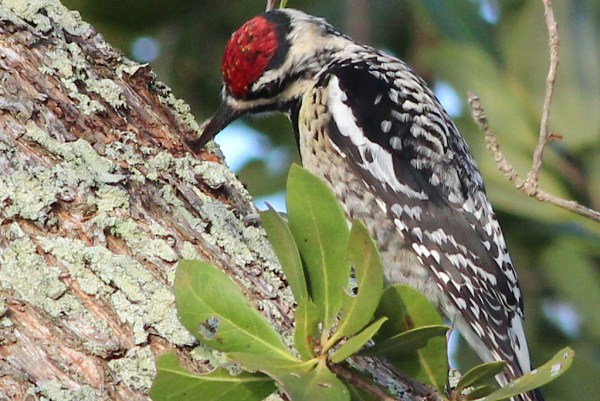
About 10 minutes later I realized I was running to a faint drumbeat. At first I thought someone who had NOT forgotten their audio equipment had the volume on their iPod turned up to 11. Once I realized the thumping came from the woods themselves, though, it wasn’t too long before I spotted the drummer, dressed more appropriately for jazz than heavy metal in the stylish black-and-white houndstooth jacket and jaunty red cap of a male downy woodpecker. In spite of the bird’s diminutive size—no more than 6” from head to tail-tip and weighing in at an ounce or less—his wardrobe set him apart on that overcast day from the slate-and-silver hickory bark backdrop.

Downy’s are capable of making a noise disproportionate to their size. When a woodpecker is looking for a mate or claiming a territory, the sound of drumming needs to carry; building a nursery cavity using a beak as a jackhammer isn’t quiet either. But if you’re in the woods and the beat is more bongo than bass, hunger is probably acting as the drummer’s muse. A gentle tap, tap, tap betrays hollow spots beneath the bark where wood-boring insect larvae wait.

drawing of a woodpecker's tongue

Woodpeckers can really stick out their tongues (Florida Center for Instructional Technology, used with permission)

Once dinner has been detected, things get… interesting. That short chisel of a beak hardly prepares you for what’s inside—like many other woodpeckers, the downy has a barbed, sticky, and flexible tongue so long it wraps around the skull when at rest. If ever there was a bird ready-made for rock ‘n roll, it’s the woodpecker. Gene Simmons got nothin’ on these headbangers.

The whole tone of my morning changed in an instant. It’s so easy to carry a personal soundtrack wherever I go that I forget about everything I normally tune out when I turn up the volume. As a result of my oversight, I suddenly had a standing-room-only ticket to a great live performance, one I would surely have missed had this excursion proceeded according to plan.  My run could wait. I stayed for several encores and gave that downy an enthusiastic round of applause as he flew off toward his next gig.

[This post was originally published in January 2011. Hope to have a new installment ready for prime-time soon.]

Would you like to find a little Next-Door Nature when you open your email? Click the “subscribe”  link in the upper right-hand corner of this page and receive notifications of new posts!
© 2011 Next-Door Nature— no reprints without written permission from the author

Read Full Post »

Older Posts »

Follow

Get every new post delivered to your Inbox.

Join 290 other followers

%d bloggers like this: